INTRODUCTION
Walk into almost any dental clinic in Whitefield and ask a patient in the waiting room whether they want “teeth cleaning” or “teeth whitening” — and many will pause. The two terms are used interchangeably in everyday conversation, often appearing side by side in dental service menus and social media ads. Yet they are fundamentally different procedures with entirely different purposes, outcomes, and oral health implications.
This confusion is understandable. Both treatments can make your smile look brighter. Both are performed by dental professionals. And both are frequently sought by the same types of patients — people who drink coffee, worry about yellowing, or simply want to feel more confident about their smile.
But here’s what matters: choosing the wrong treatment doesn’t just waste your time. It can also delay essential oral health care or set up unrealistic expectations.
This article explains — with clinical accuracy and without hype — exactly what each procedure involves, how they differ, who actually benefits from each, what dentists typically recommend, and how to decide which one is right for you. Whether you’re preparing for a wedding, concerned about tartar buildup, or simply overdue for a checkup at a dental clinic near you in Whitefield, this guide will help you make an informed decision.
WHAT IS PROFESSIONAL TEETH CLEANING?
Professional teeth cleaning, known clinically as dental prophylaxis, scaling, or scaling and polishing — is a preventive dental procedure performed by a dentist or dental hygienist. It is not a cosmetic treatment. It is an essential component of oral health maintenance.
WHAT PROFESSIONAL TEETH CLEANING INVOLVES:
1. Dental Scaling
Scaling is the process of removing calculus (tartar) and hardened plaque deposits from the surfaces of the teeth — both above the gumline (supragingival scaling) and, in more advanced cases, below it (subgingival scaling). These deposits cannot be removed by brushing or flossing at home, no matter how diligent your routine is. Once plaque mineralises into tartar, professional instruments are the only way to remove it.
Dental scaling is performed using either:
- Ultrasonic scalers: Electronic devices that use high-frequency vibrations and water to dislodge calculus efficiently
- Hand scalers (curettes): Manual instruments used to clean more precise areas and along the gumline
2. Plaque Removal
Dental plaque is a sticky, colourless biofilm of bacteria that forms continuously on tooth surfaces. When plaque isn’t removed regularly, it causes tooth decay and gum inflammation (gingivitis). Professional cleaning reaches areas between teeth and at the gumline that are easy to miss with a toothbrush.
3. Polishing
After scaling, the dentist or hygienist uses a rotating rubber cup or brush with a mildly abrasive prophylactic paste to polish the tooth surfaces. Polishing removes surface stains left by tea, coffee, and certain foods, and creates a smooth surface that is more resistant to future plaque accumulation.
What Professional Cleaning Does NOT Do
Professional teeth cleaning removes surface stains and tartar. It does not change the natural colour of your enamel. If your teeth are structurally yellow or discoloured from within, cleaning will not whiten them — that requires a separate whitening procedure.
HOW OFTEN IS TEETH CLEANING RECOMMENDED?
The American Dental Association (ADA) and most dental guidelines recommend professional teeth cleaning every 6 months for individuals with generally healthy teeth and gums. Patients with a history of gum disease, heavy tartar buildup, or certain medical conditions may be advised to come more frequently — sometimes every 3 to 4 months.
For residents of Whitefield who haven’t visited a dentist in a year or more, a professional cleaning is almost always the first recommended step before any other treatment.
WHAT IS TEETH WHITENING?
Teeth whitening is a cosmetic dental procedure designed to lighten the colour of the teeth. It does not treat decay, remove tartar, or address gum disease. Its sole purpose is aesthetic — to make the shade of your natural teeth appear lighter and more uniform.
How Teeth Whitening Works
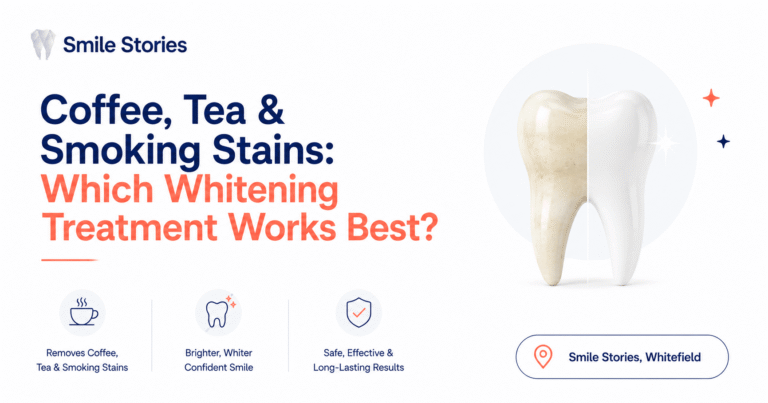
Professional teeth whitening uses peroxide-based bleaching agents — most commonly hydrogen peroxide or carbamide peroxide — to penetrate the enamel and break down the compounds responsible for tooth discolouration. The chemical reaction oxidises the chromogens (colour molecules) embedded within the tooth structure, causing the tooth to appear lighter.
External vs Intrinsic Stains
Understanding the type of stain determines whether whitening will work for you:
EXTERNAL (EXTRINSIC) STAINS
These sit on or just beneath the enamel surface and are caused by:
- Coffee, tea, and cola
- Red wine
- Tobacco (smoking or chewing)
- Certain foods (berries, sauces, curries)
- Poor oral hygiene
External stains respond well to professional whitening treatments. Many also respond partially to professional cleaning and polishing.
INTRINSIC STAINS
These are discolourations that originate within the tooth structure itself. Common causes include:
- Tetracycline antibiotic use during tooth development in childhood
- Fluorosis (excess fluoride during childhood)
- Tooth trauma causing internal bleeding within the pulp
- Aging — as enamel thins naturally, the darker dentin layer beneath becomes more visible
- Genetics — some people naturally have thicker, yellower dentin
Intrinsic stains respond variably to whitening. Some improve significantly; others require alternative cosmetic approaches such as veneers or bonding. A dentist must assess the type of staining before recommending whitening.
Types of Professional Whitening
- In-office whitening: Performed at the dental clinic, typically using a higher-concentration peroxide gel, sometimes activated by a light or laser. Results are visible immediately.
- Take-home whitening kits: Custom-fitted trays made from impressions of your teeth, combined with professional-strength whitening gel, worn at home for a dentist-prescribed duration.
Who Benefits Most from Teeth Whitening?
- Adults with healthy teeth and gums
- Patients with predominantly external/surface staining
- Brides, grooms, and individuals preparing for an important event
- People who are unhappy with the overall shade of an otherwise healthy smile
- Coffee drinkers and former smokers whose surface staining has built up over time
Whitening is not suitable for everyone. Pregnant or breastfeeding individuals, children, people with untreated decay or gum disease, and those with extensive restorations (crowns, veneers, bonding) covering front teeth are typically not candidates for whitening until specific conditions are addressed.
TEETH CLEANING VS TEETH WHITENING — FULL COMPARISON
| Feature | Professional Teeth Cleaning | Teeth Whitening |
|---|---|---|
| Primary Purpose | Preventive oral health | Cosmetic enhancement |
| Clinical Category | Preventive / Therapeutic | Cosmetic |
| What It Treats | Plaque, tartar, and surface stains | Tooth discolouration (shade) |
| Changes Natural Enamel Colour? | No | Yes |
| Suitable Candidates | All patients as part of routine dental care | Patients with healthy teeth and external staining |
| Procedure | Scaling and polishing | Peroxide-based bleaching (in-office or take-home) |
| Session Duration | 30–60 minutes | 60–90 minutes (in-office) |
| Results Visible | Immediately (surface stain removal) | Same day (in-office) or over 1–2 weeks (take-home) |
| How Long Results Last | Around 6 months with good oral hygiene | 6 months to 2 years (varies by lifestyle and habits) |
| Maintenance | Brushing, flossing, and regular 6-month dental visits | Avoid staining foods and drinks; maintenance trays or touch-ups if needed |
| Impact on Oral Health | Significant—helps prevent gum disease and tooth decay | Minimal—primarily cosmetic |
| Cosmetic Impact | Moderate—removes surface stains | High—lightens the natural tooth shade |
| Recommended Before Whitening? | Yes—improves whitening results | N/A |
| Can Be Done Without Cleaning? | Yes | Not recommended |
| Recommended Frequency | Every 6 months | As needed, typically once a year or less |
WHICH TREATMENT DO YOU ACTUALLY NEED?
The right treatment depends on your specific oral health status and cosmetic goals — not on which procedure sounds more appealing. Here are common patient scenarios and evidence-based guidance for each:
SCENARIO 1: “My teeth look yellow from years of coffee and tea drinking.”
You likely have external staining. A professional cleaning with polishing may remove a significant amount of this discolouration without the need for whitening at all. If staining remains after cleaning, whitening can then be assessed. Most dentists recommend cleaning first — both because it improves whitening outcomes and because the dentist can evaluate the actual shade beneath the stains before proceeding.
Recommendation: Cleaning first, then reassess.
SCENARIO 2: “I can see a buildup of yellowish deposits at the base of my teeth near the gums.”
This describes tartar (calculus), not cosmetic staining. No amount of whitening will remove tartar — only professional scaling will. Additionally, the gum inflammation caused by tartar buildup must be addressed before any cosmetic work can be safely recommended.
Recommendation: Professional scaling (cleaning) is the only appropriate treatment.
SCENARIO 3: “I’m getting married in 6 weeks and want a noticeably brighter smile.”
For special occasion preparation, whitening can deliver visible results within the treatment window. However, dentists will want to ensure your gums and teeth are healthy before initiating whitening. A cleaning and oral examination in the weeks prior is advisable.
Recommendation: Oral exam + cleaning, followed by professional whitening if teeth and gums are healthy.
SCENARIO 4: “I’m a smoker and my teeth are heavily stained.”
Smoking causes both surface staining (which responds to cleaning and polishing) and more deeply embedded staining within the enamel that may require whitening to address. Importantly, smoking also significantly increases the risk of gum disease and oral cancer — a dental examination and cleaning take priority over cosmetic work.
Recommendation: Comprehensive dental examination, cleaning and scaling, then whitening if gum health allows.
SCENARIO 5: “My teeth feel sensitive to cold and hot, and I’m considering whitening.”
Existing tooth sensitivity is a contraindication for many whitening formulations. Whitening can temporarily increase sensitivity, and using it on already-sensitive teeth can result in significant discomfort. The underlying cause of sensitivity — exposed dentin, enamel erosion, gum recession — must be investigated and managed first.
Recommendation: Dental examination to assess and manage sensitivity before any whitening.
SCENARIO 6: “My teeth are clean and healthy, but my smile looks dull and I want a brighter shade.”
This is the ideal candidate for whitening. With healthy gums, no significant tartar buildup, and predominantly external staining (or mild intrinsic shade concerns), professional whitening is appropriate and can deliver meaningful results.
Recommendation: Confirm oral health with a routine examination and cleaning, then proceed with whitening.
SCENARIO 7: “I haven’t been to the dentist in 2 or more years.”
Regardless of your cosmetic goals, an examination and cleaning are the appropriate first steps. A dentist at a clinic near you in {City} can identify any decay, gum disease, or oral health issues that need to be addressed before cosmetic treatment is considered.
Recommendation: Oral examination + professional cleaning. Cosmetic options can be discussed once baseline health is established.
CAN TEETH CLEANING MAKE YOUR TEETH LOOK WHITER?
Yes — but within specific limits that are important to understand.
Professional teeth cleaning, particularly the polishing stage, effectively removes extrinsic stains from tea, coffee, tobacco, and food pigments that have accumulated on the tooth surface. After a scaling and polishing session, many patients notice that their teeth appear noticeably cleaner, brighter, and more even in tone.
However, cleaning does not bleach the enamel or change the structural colour of your teeth. If your teeth are naturally a darker shade of ivory or yellow, cleaning will restore them to their natural colour — not to a shade lighter than that.
Think of it this way: Cleaning removes the layer of discolouration sitting on top of your teeth. Whitening changes the colour of the tooth itself, from the inside out.
For patients in Whitefield who are considering whitening primarily because their teeth look stained, it is worth undergoing a professional clean first. In a meaningful proportion of cases, patients are satisfied with the results of cleaning alone and find whitening unnecessary.
CAN YOU GET WHITENING WITHOUT CLEANING FIRST?
Technically, whitening can be performed without prior cleaning — but most dental professionals will not recommend this approach, and for good reason.
WHY DENTISTS RECOMMEND CLEANING BEFORE WHITENING:
1. Better and more uniform results
Whitening gel needs to come into direct contact with clean tooth surfaces to work effectively. Plaque, tartar, and surface stains act as barriers that prevent even distribution of the bleaching agent. Teeth that haven’t been cleaned prior to whitening often show patchy or uneven results.
2. Oral health assessment
The pre-whitening cleaning appointment also functions as a dental examination. A dentist checks for decay, gum disease, cracked teeth, and other conditions that could be worsened by whitening agents. Starting whitening without this evaluation carries clinical risk.
3. Gum health protection
Whitening agents can cause gum irritation, particularly if the gum tissue is already inflamed from plaque accumulation. Reducing gingival inflammation through cleaning before whitening makes the procedure more comfortable and reduces the risk of soft tissue irritation.
4. Accurate shade assessment
After cleaning and stain removal, a dentist can accurately assess your tooth’s natural baseline shade and set realistic expectations for whitening outcomes.
The standard recommendation from dentists across whitefield and globally is: cleaning first, whitening second.
BENEFITS OF PROFESSIONAL TEETH CLEANING
Professional dental cleaning delivers benefits that extend well beyond a brighter smile. It is one of the most clinically impactful preventive treatments available:
1. Prevention of Gum Disease
Tartar buildup is the primary driver of gingivitis (early gum inflammation) and periodontitis (advanced gum disease involving bone loss). Regular cleaning removes the bacterial deposits responsible, interrupting the disease process before it causes lasting damage.
2. Prevention of Tooth Decay
Plaque bacteria produce acids that erode tooth enamel and initiate cavities. Professional removal of plaque — particularly from hard-to-reach areas — reduces this acid attack and protects the tooth structure.
3. Early Detection of Dental Problems
A cleaning appointment includes clinical examination. Dentists and hygienists routinely identify early-stage decay, cracked teeth, oral lesions, and beginning signs of gum disease during cleaning visits. Conditions caught early are significantly easier and less involved to treat.
4. Fresher Breath
Persistent bad breath (halitosis) is frequently caused by bacteria in plaque and tartar deposits, as well as food debris trapped between teeth and below the gumline. Professional cleaning eliminates these sources, providing a meaningful and lasting improvement in breath freshness that no mouthwash can replicate at the source.
5. Improved Systemic Health
Research consistently links poor oral hygiene and untreated gum disease to systemic health conditions including cardiovascular disease, diabetes complications, and adverse pregnancy outcomes. Professional cleaning supports not just oral health but overall wellbeing.
6. A Cleaner, Brighter Baseline
While not its primary purpose, cleaning provides a cosmetically cleaner, smoother, and often noticeably brighter smile — particularly for patients with significant surface staining.
Regular teeth cleaning at a family dentist or dental clinic near you in whitefield is recommended every 6 months as part of a complete oral health routine.
BENEFITS OF TEETH WHITENING
For patients who are candidates, professional teeth whitening delivers benefits that are primarily cosmetic but meaningfully impact confidence and social wellbeing:
1. Significantly Brighter Smile
Professional whitening achieves results that no over-the-counter product can match. In-office treatments use higher concentrations of whitening agents under controlled conditions, delivering faster and more dramatic shade improvement.
2. Improved Smile Confidence
Studies in dental psychology consistently show that patients who undergo teeth whitening report higher confidence in social and professional situations. Smile aesthetics have a documented impact on first impressions, job interview outcomes, and relationship satisfaction.
3. Even Colour Across Teeth
Professional whitening, particularly with custom-fitted trays, ensures even distribution of the whitening agent across all tooth surfaces — producing a uniform result rather than patchy improvements from strips or rinses.
4. Special Occasion Preparation
For weddings, family portraits, professional headshots, milestone birthdays, or job interviews, professional whitening provides a confidence boost that has a clear and immediate application.
5. Reverses Years of Staining
Years of cumulative surface and enamel staining from diet and lifestyle can be significantly reduced in a single whitening session, restoring a more youthful and vibrant tooth shade.
6. Safe When Properly Supervised
Under professional supervision — with prior oral health assessment, appropriate shade selection, and correct agent concentration — teeth whitening has an excellent safety profile. Sensitivity, when it occurs, is typically transient and resolves within 24–72 hours.
For residents of whitefield interested in cosmetic dental improvements, whitening is one of the most accessible and time-efficient options available — when the oral health foundation is in place first.
RISKS OF CHOOSING THE WRONG TREATMENT
Understanding what happens when patients choose based on assumption rather than clinical assessment:
RISK 1: Whitening Over Active Gum Disease or Untreated Decay
Whitening agents are not selective. They penetrate enamel, and if there is decay (a cavity), an exposed root surface, or cracked enamel, the peroxide can reach the sensitive inner layers of the tooth — causing significant pain and potentially worsening the existing condition. This is why dentists insist on an oral health assessment before whitening.
RISK 2: Using Whitening to Mask a Deeper Problem
Some patients seek whitening when the underlying issue is tartar buildup, gum disease, or a dying tooth that is darkening from within. Whitening won’t address any of these — it only alters the surface appearance temporarily. The underlying problem continues to progress.
RISK 3: Skipping Cleaning and Expecting Whitening to “Fix Everything”
Whitening does not remove plaque, tartar, or the bacterial deposits causing gum inflammation. A patient who skips cleaning and goes straight to whitening will have a lighter-coloured but potentially unhealthy mouth — an aesthetic outcome built on a compromised foundation.
RISK 4: Unrealistic Expectations from Cleaning Alone
On the other side, patients with deeply embedded intrinsic staining who expect cleaning and polishing to dramatically whiten their teeth will be disappointed. Cleaning has a real but limited cosmetic impact — and that limit should be communicated clearly before treatment.
RISK 5: Delayed Diagnosis
Any patient who visits a cosmetic dentist near them in whitefield solely for whitening, without an accompanying oral examination, may have undetected decay, early oral lesions, or gum disease identified. Choosing a clinic that always pairs cosmetic consultations with clinical assessment is important.
WHAT DENTISTS TYPICALLY RECOMMEND
The dental profession’s universal starting point is the same regardless of a patient’s cosmetic goals: a comprehensive oral examination and professional cleaning.
WHY DENTISTS INSIST ON ASSESSMENT FIRST:
- No two patients have the same oral condition. What works for one person may be inappropriate or counterproductive for another.
- Teeth that look superficially similar may have very different underlying conditions. Only clinical examination and, where indicated, dental X-rays can reveal what’s happening beneath the surface.
- Treating cosmetically without addressing underlying oral health problems leads to short-term results that quickly reverse — and sometimes worsens the underlying condition.
THE STANDARD CLINICAL APPROACH:
Step 1: Oral Examination
A full examination of teeth, gums, tongue, and oral soft tissues. X-rays where indicated. Assessment of existing restorations (fillings, crowns, veneers).
Step 2: Professional Cleaning
Scaling, plaque removal, and polishing. This establishes a healthy baseline and reveals the true shade of the teeth beneath staining.
Step 3: Cosmetic Consultation
After cleaning, the dentist can accurately discuss whitening options, realistic outcomes, appropriate treatment timing, and maintenance strategies — personalized to the individual patient.
Step 4: Treatment and Follow-Up
Whitening treatment, if appropriate, followed by regular maintenance cleaning and check-up schedule.
For anyone in whitefield considering either treatment for the first time, the recommendation is consistent: book a consultation and oral examination with a qualified dentist near you, rather than requesting a specific treatment without prior assessment.
COMMON MYTHS ABOUT TEETH CLEANING AND WHITENING — DEBUNKED
MYTH 1: “Teeth cleaning damages enamel.”
Professional scaling and polishing, performed by a trained dental professional, does not damage enamel. Ultrasonic scalers and polishing instruments are designed to remove deposits from tooth surfaces without abrading the enamel beneath. This myth typically originates from the sensation of the procedure — which can feel intense — rather than any actual harm.
MYTH 2: “Whitening weakens teeth.”
Professional whitening, performed according to clinical guidelines and with appropriate agent concentrations, does not weaken tooth structure. Temporary sensitivity is common but resolves quickly. There is no clinical evidence that professionally supervised whitening compromises enamel integrity when used correctly.
MYTH 3: “Over-the-counter whitening strips are just as effective as professional treatment.”
OTC products use significantly lower concentrations of whitening agents than professional treatments. They also use one-size-fits-all trays that provide less even coverage than custom-fitted professional trays. For mild surface staining, they may provide some improvement; for meaningful shade change, they are significantly less effective.
MYTH 4: “Once whitened, teeth stay white forever.”
Whitening results are not permanent. The longevity of results depends on diet, oral hygiene, and lifestyle habits (particularly tobacco use and consumption of staining beverages). Most patients require maintenance whitening periodically — either through touch-up treatments or at-home maintenance trays provided by their dentist.
MYTH 5: “If my teeth are clean at home, I don’t need professional cleaning.”
Even the most diligent home oral hygiene routine cannot remove calculus once it has formed. Brushing and flossing prevent plaque from hardening into tartar — they cannot remove tartar that has already calcified. Professional cleaning is necessary regardless of home hygiene quality.
MYTH 6: “Whitening works on crowns, veneers, and fillings.”
Whitening agents only affect natural tooth enamel. They have no effect on dental restorations — including crowns, composite bonding, veneers, or porcelain. Patients with visible front restorations who whiten their natural teeth may find that the restorations no longer match the lighter shade of surrounding teeth.
CONCLUSION
Teeth cleaning and teeth whitening are not competing treatments — they serve entirely different purposes and address different aspects of your dental wellbeing.
Professional teeth cleaning is a foundational oral health procedure. It removes bacterial plaque and hardened tartar, prevents gum disease and decay, supports fresh breath, enables early detection of dental problems, and provides a cleaner baseline smile. It is recommended for everyone, regardless of cosmetic goals, at least every 6 months.
Teeth whitening is a cosmetic procedure. It lightens the shade of your enamel by oxidising discolouration within the tooth structure. It delivers meaningful aesthetic results for appropriate candidates, but it does not treat decay, tartar, or gum disease.