If you work near ITPL, in the EPIP Zone, or anywhere in the Whitefield corridor, you already know how quickly the week disappears. Between back-to-back meetings, project deadlines, and the daily commute across East Bangalore, personal health appointments — especially dental ones — tend to get postponed. Not because they are unimportant, but because finding a convenient slot that does not disrupt a full workday feels like one more problem to solve.
The reality is that professional teeth cleaning is one of the shortest, most predictable appointments in healthcare. A routine teeth cleaning takes 30–60 minutes, involves no recovery time, no dietary restrictions, and no restrictions on returning to work immediately after. Most patients leave the appointment feeling fresher and more comfortable — not inconvenienced.
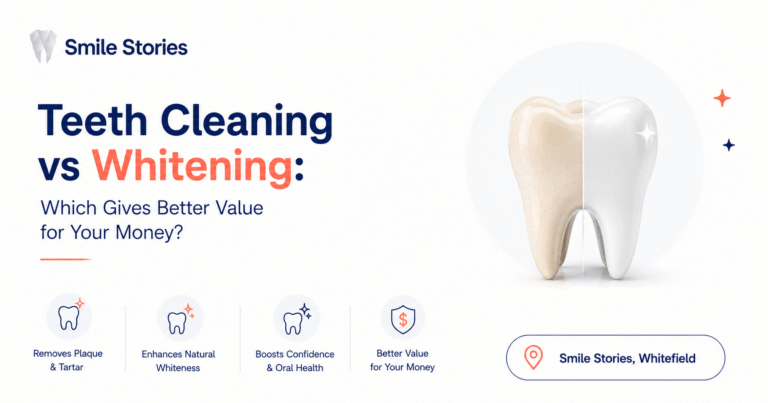
This guide is written specifically for working professionals around the Whitefield area who want to understand what professional teeth cleaning involves, why it matters beyond aesthetics, how to recognize when a cleaning is overdue, and how to fit an appointment into a week that already feels full. If you’re unsure whether you need a routine cleaning or a cosmetic whitening treatment, understanding the difference between Teeth Cleaning vs Teeth Whitening can help you choose the right procedure for your oral health and smile goals.
WHY REGULAR TEETH CLEANING MATTERS
Professional teeth cleaning — clinically known as dental prophylaxis, or scaling and polishing — is not simply a cosmetic service. It is the foundational preventive dental procedure that removes what daily brushing and flossing cannot.
The Problem with Plaque and Tartar
Dental plaque is a sticky, colourless biofilm of bacteria that forms continuously on tooth surfaces. Every time you eat or drink, bacteria in plaque metabolize sugar and produce acids that attack tooth enamel — the outer protective layer of the tooth. Regular brushing removes plaque effectively when it is soft and fresh.
The issue arises when plaque is not consistently removed. Within 24–72 hours, plaque begins to harden through mineral deposits from saliva — a process called calcification. The hardened deposit is called calculus or tartar. Calculus cannot be removed by brushing or flossing, regardless of technique or toothbrush quality. It requires professional instruments — ultrasonic scalers and hand curettes — to remove safely.
Why This Matters Beyond Appearance
Calculus accumulation at and below the gumline is the primary driver of gingivitis (early gum inflammation) and, if left unaddressed over time, periodontitis — advanced gum disease involving infection, bone destruction, and eventual tooth loss. Gum disease is the leading cause of tooth loss in adults globally, according to the World Health Organization (WHO).
Plaque that penetrates between the tooth and gumline also produces the conditions for root caries — decay at the root level of the tooth — which is significantly more complex to treat than cavity decay in the enamel.
The Oral Health Benefits of Regular Professional Cleaning
Prevention of Gum Disease: Removing calculus deposits eliminates the primary source of chronic gum inflammation. Patients who maintain 6-monthly professional teeth cleaning appointments have consistently lower rates of gum disease progression than those who skip.
Prevention of Cavities: Plaque removal through professional teeth cleaning, combined with polishing, reduces the bacterial load and acid environment that drives tooth decay.
Early Detection: A teeth cleaning appointment includes clinical examination. Dentists and dental hygienists identify early-stage decay, cracked teeth, gum recession, soft tissue changes, and early oral lesions during teeth cleaning visits — when treatment is simplest and most conservative.
Fresher Breath: Persistent bad breath (halitosis) in otherwise healthy individuals is most commonly caused by bacteria in calculus deposits and trapped food debris in periodontal pockets. Professional teeth cleaning addresses these sources directly, providing lasting improvement in breath quality.
Better Appearance: Polishing removes surface stains from tea, coffee, and food pigments that accumulate on enamel over months. A post-cleaning smile is noticeably cleaner and brighter — without any whitening procedure being required.
WHY OFFICE PROFESSIONALS OFTEN DELAY DENTAL TEETH CLEANING
Anyone who works in the technology, financial, or corporate sectors around ITPL and Whitefield will recognize this pattern: dental care gets scheduled, then rescheduled, then eventually deferred to “after this sprint” or “once the quarter closes.”
Several specific factors compound this tendency in the working population of East Bangalore:
1. Long and Unpredictable Working Hours
Many professionals working in tech parks around ITPL, the EPIP Zone, and Brookefield work extended hours — often with little advance certainty about when the day will actually end. Booking a late-morning or mid-afternoon dental appointment feels risky when a 3 PM standup could extend to 5 PM without notice.
2. Meeting-Heavy Schedules
Knowledge workers in particular may find entire days blocked with meetings, leaving no natural break during which an appointment could be accommodated without significant schedule reorganization.
3. Travel and Remote Work Cycles
Professionals who divide their time between home, office, and business travel have irregular routines that make standing health appointments difficult to maintain. A twice-yearly dental teeth cleaning that falls during a travel week gets rescheduled once, then again, until more than a year has passed without a professional teeth cleaning.
4. Perception of Low Urgency
Unlike a fever or acute pain, gum disease and plaque accumulation are asymptomatic for a long time. Patients who are not experiencing tooth pain or visible bleeding do not feel urgency — and this perception of “I’ll go when something hurts” is medically counterproductive. By the time symptoms emerge, early-stage, easily treated conditions have often progressed.
5. Coffee, Tea, and Desk Habits
Professionals who work long hours often rely heavily on coffee and tea throughout the day. Both contain tannins and chromogens that stain tooth surfaces over time. Many corporate employees drink three to five cups daily — and often sip continuously at their desk without rinsing. This creates a sustained staining and acid environment that accelerates surface discolouration and, at some level, enamel erosion.
6. Stress and Sleep Deprivation
Chronic work stress is associated with teeth grinding (bruxism), which most people do during sleep without awareness. Grinding accelerates tooth wear, increases the risk of cracked teeth, and contributes to jaw pain — all of which are detected most readily during a routine dental examination accompanying a teeth cleaning visit.
CONVENIENT TEETH CLEANING FOR PROFESSIONALS AROUND ITPL WHITEFIELD
The structural reason most working professionals skip dental appointments is not disinterest — it is the friction of fitting a weekday daytime appointment into an already-committed schedule. Dental clinics serving the ITPL and Whitefield professional community have increasingly adapted their appointment models to address this.
Appointment Flexibility That Works Around Office Hours
1. Before-Office Appointments
Early morning slots — often starting at 8:00 or 8:30 AM — allow professionals to complete a teeth cleaning before the office workday begins. A 45-minute teeth cleaning appointment before 9 AM has no impact on professional availability and leaves the entire working day uninterrupted.
2. Lunch-Break Appointments
A routine professional cleaning for a patient with generally healthy gums and no significant calculus buildup can comfortably be completed in 30–45 minutes. For employees working in offices around Pattandur Agrahara, Kundalahalli, or within the ITPL campus itself, a dental clinic within 10–15 minutes of the office makes a lunch-break appointment entirely feasible.
3. Evening Appointments
Clinics in the Whitefield area that offer appointments extending to 7:00 or 7:30 PM allow professionals to schedule after work without taking time away from the working day. Evening cleaning appointments have become increasingly popular among IT professionals in the Brookefield, Hoodi, and Mahadevapura areas.
4. Weekend Availability
Saturday morning appointments are particularly sought after by working professionals who prefer to complete health appointments on their day off. Many dental clinics in and around Whitefield offer Saturday hours — confirming availability when booking is advisable, as weekend slots fill faster than weekday ones.
Planning Your Appointment
For most patients with generally good oral health, a professional cleaning appointment slot of 45–60 minutes is sufficient. Patients who have not had a cleaning in over a year, or who have significant calculus buildup or early gum disease, may require a longer appointment or a second session.
Calling ahead or booking online allows the clinic to allocate the right appointment duration and schedule around your availability. Most clinics in the ITPL-Whitefield corridor can accommodate short-notice bookings for routine cleaning — particularly during weekday morning or early evening slots.
WHAT HAPPENS DURING A PROFESSIONAL TEETH CLEANING APPOINTMENT
Many patients who have never had a professional cleaning — or have not had one in several years — are unsure what the appointment involves. Here is a clear, step-by-step overview of what to expect:
Stage 1: Oral Examination
Before cleaning begins, the dentist or dental hygienist performs a brief examination of the teeth, gums, and soft tissues. This identifies any areas of concern — signs of decay, gum inflammation, recession, or suspicious lesions — that may need attention or that will affect how the cleaning is conducted.
In many clinics, a basic oral health questionnaire or update of your medical history is also completed at the start of the visit, particularly for patients returning after a gap of more than 12 months.
Stage 2: Scaling (Tartar and Calculus Removal)
The core clinical step. Using an ultrasonic scaler — a vibrating tip that uses high-frequency movement and a water spray — the dental professional removes calculus deposits from the tooth surfaces above and around the gumline (supragingival scaling). For patients with early gum disease or deeper deposits, hand scalers (curettes) may be used to clean more precisely below the gumline (subgingival scaling).
The ultrasonic instrument makes a distinctive sound and produces some vibration sensation — most patients describe this as the most unfamiliar part of the experience, though not painful. The water spray used simultaneously clears debris and cools the tooth surface.
Stage 3: Plaque Removal
Fine manual instruments remove residual plaque from between teeth and at the gum margin — areas that the ultrasonic scaler may not reach precisely. This step ensures thorough removal of soft deposits from all accessible tooth surfaces.
Stage 4: Polishing
After scaling, a rotating rubber cup or brush with prophylaxis paste — a mildly abrasive polishing compound — is used to smooth and polish tooth surfaces. Polishing removes extrinsic stains (from tea, coffee, and food pigments) and creates a smooth enamel surface that is more resistant to new plaque attachment.
This is the step that produces the immediate visible improvement most patients notice after a cleaning. Teeth look noticeably cleaner, and the surface feels smooth to the tongue in a way that brushed-but-unpolished teeth do not.
Stage 5: Interdental Cleaning (Flossing)
The dental professional flosses between each tooth to remove any remaining debris from interproximal (between-tooth) surfaces and to check gum health at these contact points.
Stage 6: Oral Hygiene Guidance
A professional cleaning appointment is also an opportunity for personalized oral hygiene instruction. The dentist or hygienist may demonstrate improved brushing technique, recommend an appropriate toothbrush type, discuss flossing or interdental brush use, and advise on diet or lifestyle factors specific to the patient’s oral health status.
This step is particularly relevant for working professionals who drink multiple cups of coffee or tea daily — specific guidance on timing, rinsing habits, and maintenance products makes a measurable difference in the rate at which staining and plaque re-accumulate.
Stage 7: Fluoride Application (Where Indicated)
For patients with elevated decay risk — including those with dry mouth, exposed root surfaces, or a history of frequent cavities — a topical fluoride application may be recommended after polishing. This involves a fluoride-rich gel or varnish applied briefly to the tooth surfaces to strengthen enamel and support remineralization.
Stage 8: Recall Scheduling
The appointment concludes with a recommendation for the next cleaning interval. For patients with healthy gums and minimal calculus buildup, 6-monthly professional cleaning is standard. For patients with a history of gum disease, elevated calculus accumulation, or specific risk factors, a 3-4 monthly interval may be recommended.
COMMON SIGNS YOU MAY NEED PROFESSIONAL CLEANING
The following signs suggest that a professional cleaning appointment is overdue. Many professionals in and around the Whitefield area notice these symptoms and address them intermittently with home remedies — but professional cleaning is the only clinical resolution for most of these.
1. Bleeding Gums When Brushing
Gums that bleed during or after brushing are not a sign of brushing too hard. They are a sign of gum inflammation — specifically, gingivitis caused by bacterial plaque and calculus accumulation at the gumline. Bleeding gums that do not resolve within a week of improved brushing warrant a professional assessment.
2. Persistent Bad Breath
Breath that remains unpleasant despite regular brushing, flossing, and mouthwash use is almost always rooted in calculus deposits, food trapped in periodontal pockets, or early gum disease. Mouthwash masks the odour temporarily; professional cleaning addresses the source.
3. Visible Yellow or Brown Deposits
Hard, discoloured deposits on the tooth surface — particularly visible near the gumline of lower front teeth — are calculus. These deposits are not removable by brushing and indicate it is past time for a professional cleaning.
4. Rough or Gritty Tooth Surfaces
Teeth that feel rough to the tongue, or that food seems to stick to more than usual, may have significant plaque or early calculus accumulation on their surfaces.
5. Tooth Staining from Coffee, Tea, or Tobacco
Surface staining from daily beverages or tobacco use is removed during professional polishing. Patients who consume multiple cups of coffee or tea daily — a common reality in the ITPL and tech park environments — typically notice visible surface discolouration within 3–6 months of their last cleaning.
6. Sensitive or Tender Gums
Gums that feel tender, look darker red than normal, or are slightly swollen around the teeth are showing early signs of inflammation. This stage of gum disease — gingivitis — is completely reversible with professional cleaning and improved home care.
7. More than 6 Months Since Last Cleaning
Even in the absence of visible symptoms, if the last professional cleaning was more than 6 months ago, it is appropriate to schedule one. Many of the changes that precede gum disease develop below clinical visibility — detectable by a professional, invisible to the patient.
BENEFITS OF PREVENTIVE TEETH CLEANING
For working professionals, the value of regular preventive dental cleaning extends well beyond oral health alone.
1. Healthier Gums, Maintained Over Time
Patients who attend professional cleaning on a consistent 6-monthly basis have significantly lower rates of gum disease progression and tooth loss over their lifetime. Preventive investment is far simpler — and requires less total time — than managing the consequences of neglected gum disease.
2. Cleaner, More Comfortable Teeth
The smooth, polished surface that follows professional cleaning improves daily oral comfort and reduces the rate at which plaque re-accumulates. Many patients notice that brushing feels more effective and thorough after a cleaning.
3. Reduced Risk of Costly Future Treatment
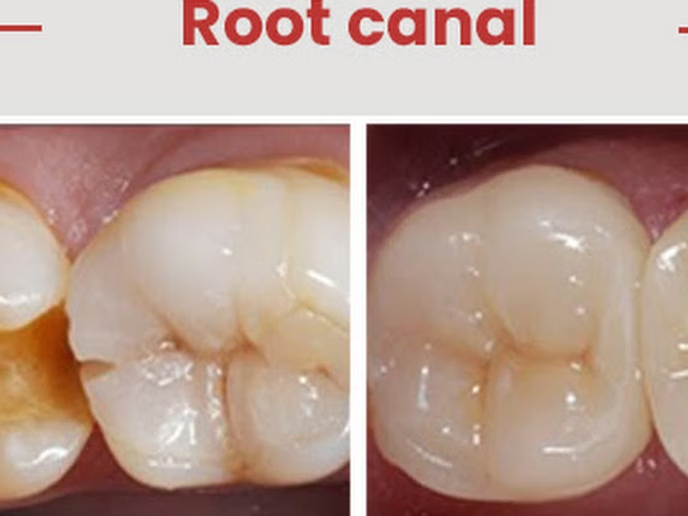
Treating a cavity detected at a cleaning appointment requires a straightforward filling. The same cavity, left undetected for a year or two, may require root canal treatment and a crown. Regular cleaning appointments that include oral examination are cost-effective in the most direct sense — they intercept clinical problems at their simplest and most treatable stage.
4. Improved Appearance
Surface stains from daily coffee and tea consumption are removed during polishing — without whitening agents or additional cosmetic procedures. For professionals who interact with clients, attend meetings, or appear on video calls, the visible impact of a professional cleaning is often immediately noticeable and confidence-enhancing.
5. Early Detection of Oral Conditions
The clinical examination that accompanies a cleaning visit allows detection of early-stage decay, cracked teeth, gum recession, and — importantly — oral lesions that may require further evaluation. Oral cancer, gum disease, and certain systemic conditions first manifest in the oral cavity. Regular attendance means these are identified earlier, when outcomes are consistently better.
MAINTAINING ORAL HYGIENE BETWEEN DENTAL VISITS
Professional cleaning provides a reset — a thorough removal of what has accumulated since your last visit. What happens in the weeks and months between appointments determines how quickly deposits re-accumulate and how much clinical work is needed next time.
1. Brushing: The Right Technique Matters
Brush twice daily — morning and before bed — using a soft-bristled toothbrush and fluoride toothpaste. The technique matters as much as frequency. Use gentle circular or Bass method strokes at the gumline — not aggressive back-and-forth scrubbing, which can contribute to gum recession and enamel abrasion over time. Electric toothbrushes with pressure sensors can help patients who brush too hard without realizing it.
2. Flossing: Daily, Not Optional
Flossing once daily removes plaque from between the teeth — the precise area that calculus most commonly forms and where gum disease begins. For professionals who find standard floss awkward, floss picks, interdental brushes, or water flossers are effective alternatives.
3. Mouthwash: Adjunct, Not Replacement
An alcohol-free fluoride or antibacterial mouthwash used after brushing provides an additional protective layer — but does not replace brushing or flossing. Choose alcohol-free formulations to avoid the drying effect of alcohol-based rinses, particularly important for coffee drinkers whose saliva production may already be slightly reduced.
4. Diet and Hydration
Reducing the frequency of sugary snacks between meals limits the acid attacks that drive enamel erosion and cavity formation. Sipping water regularly throughout the working day supports saliva production (a critical oral protective factor), washes food debris from tooth surfaces, and reduces the concentration of staining compounds from tea and coffee.
5. Post-Coffee Rinsing
For professionals in ITPL and Whitefield offices who drink multiple cups of coffee or tea daily, rinsing with water after each cup reduces the dwell time of tannins and chromogens on enamel. It is a 10-second habit that meaningfully slows the rate of surface staining between professional cleaning appointments.
6. Tongue Cleaning
A tongue scraper or soft toothbrush used on the tongue surface daily reduces bacterial accumulation that contributes to bad breath — a professional concern for client-facing employees and those working in shared office environments.
WHY LOCATION CONVENIENCE MATTERS FOR WORKING PROFESSIONALS
Whitefield is one of Bangalore’s most densely developed professional corridors. ITPL — the International Tech Park Bangalore — anchors a cluster of technology companies, multinational offices, and startup campuses that extends through the EPIP Zone, Pattandur Agrahara, and Graphite India into Brookefield and Hoodi. Further into the residential areas of Kadugodi, Hope Farm, and Varthur, large residential populations of tech professionals, families, and young workers have grown up around the employment hub.
The practical consequence of this density is that dental care located close to where people work — or positioned between work and home along established commute routes — is significantly more likely to be visited regularly than care requiring a special trip across the city.
For a professional working in the SAP Labs area, Prestige Shantiniketan vicinity, or the ITPL campus itself, a dental clinic within 10–15 minutes of the office makes the difference between a cleaning that actually happens every 6 months and one that gets deferred repeatedly because the commute time feels prohibitive.
The same logic applies to professionals living in the residential pockets of Kundalahalli, Mahadevapura, and Varthur — where an appointment on the way home from work requires minimal additional travel and can be incorporated into an existing routine.
Proximity reduces friction. Reduced friction increases the likelihood of consistent attendance. And consistent attendance is precisely what delivers the cumulative benefit that makes preventive dental cleaning so clinically valuable over a professional career of 20 or 30 years.
Conclusion:
If your last professional cleaning was more than 6 months ago — or if you cannot quite remember when it was — it is the right time to schedule one.
A professional cleaning is one of the few health appointments that genuinely fits into a busy professional schedule. It requires no preparation, no recovery, no dietary restrictions, and no time off work. An early morning, lunch-break, or evening slot at a dental clinic near ITPL or in the Whitefield area means the appointment happens without reorganizing your day.
For working professionals around ITPL, Brookefield, Kadugodi, Hoodi, Hope Farm, and across East Bangalore — preventive dental care is accessible, practical, and one of the most time-efficient investments in long-term health available.
Book at a time that works for you. Your teeth will be better for it — and your working week will not miss a beat.