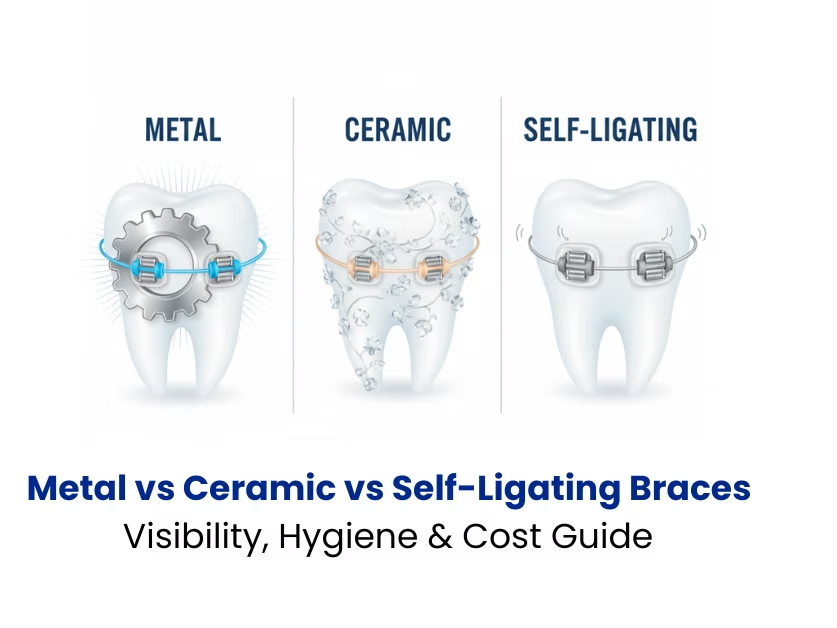
Struggling to decide which braces are right for you? Metal, ceramic, and self-ligating systems each come with their own benefits — but the right choice depends on visibility, comfort, speed, lifestyle, and budget. If you want straighter teeth without surprises, this clear real-world breakdown will help you choose confidently. Whether you’re a working professional, student, or adult wanting subtle treatment, this guide compares appearance, hygiene, cost, and comfort based on actual clinical cases from Whitefield, Bangalore — and shows you how to book the right orthodontist for your smile.
Shortcut Summary
Understanding the Three Types of Braces
Metal Braces: Strongest, Fastest & Most Affordable
Metal braces remain the most reliable orthodontic system because they offer maximum control for your doctor. For teens, complex bite corrections, and cases with rotated or crowded teeth, metal braces deliver predictable results at the best price.
Why patients choose metal braces:
- Strongest bracket system
- Works exceptionally well for severe crowding or crossbites
- Quickest to adjust and tighten
- Most affordable option in Bangalore
- Ideal for teenagers and high-movement cases
Possible concerns:
- High visibility
- More frequent cleaning required
- Not preferred for camera-facing professionals
If you want maximum correction at minimum cost, metal braces are the perfect choice — especially for growing kids and complex orthodontic issues.
Ceramic Braces: Discreet, Tooth-Colored & Aesthetic
Ceramic braces are the go-to option for adults and working professionals who want straighter teeth without drawing attention. The brackets blend with your natural tooth shade, making them significantly less noticeable in conversations and photos.
Why patients love ceramic braces:
- Tooth-coloured brackets blend in naturally
- Ideal for offices, client-facing roles & public speakers
- Offers better aesthetics than metal braces
- Great balance of visibility + effectiveness
Things to consider:
- Slightly more fragile than metal
- Requires extra care to avoid staining (especially rubber ligatures)
- Can be slightly slower for complex movements
Choose ceramics when you want braces that look clean, subtle, and professional, while still offering strong orthodontic performance.
Self-Ligating Braces: Faster, Cleaner & Fewer Visits
Self-ligating braces use advanced clip mechanisms instead of rubber bands, allowing teeth to move with less friction and more efficiency. They are a favourite among busy professionals and adults who want faster treatment + fewer clinic visits.
Why self-ligating braces feel premium:
- No rubber ties = cleaner, more hygienic
- Reduced friction = smoother, faster tooth movement
- Fewer monthly checkups required
- Superior comfort during tightening
- Great option for adults who want a clean, minimalist look
Things to keep in mind:
- Higher price point than metal & ceramic
- Limited aesthetic options compared to clear aligners
If your priority is comfort, hygiene, and speed, self-ligating braces offer the best long-term experience and often shorten overall treatment time.
Visibility Comparison: How Noticeable Are Metal, Ceramic & Self-Ligating Braces?
Choosing braces often comes down to one biggest question: “How visible will they be when I smile, talk, or take photos?”
Here’s the real-world clarity you need based on everyday situations in office meetings, college classrooms, selfies, and conversations.
Visibility Rating (Real-Life Situations)
Below is a simple visual-scale comparison using actual bracket behaviour, not stock images.
Conversation Distance (2–3 feet away):
- Metal Braces: ⭐⭐⭐⭐⭐ (Most visible — reflect light easily)
- Ceramic Braces: ⭐⭐☆☆☆ (Blend with teeth — often unnoticed)
- Self-Ligating Braces: ⭐⭐⭐☆☆ (Visible but sleeker than metal)
Office / Workplace Meetings:
- Metal: Noticeable, especially when speaking.
- Ceramic: Perfect for professionals — usually only visible on close inspection.
- Self-Ligating: Moderately aesthetic, slimmer profile.
Photos & Social Media:
- Metal: High shine; easily stands out in pictures.
- Ceramic: Smooth, muted look — blends into smile.
- Self-Ligating: Slight shine but less bulky.
Close-Up Conversations:
- Metal: Very visible
- Ceramic: Mildly visible
- Self-Ligating: Moderately visible depending on bracket design
Visibility in Different Lighting Conditions
Lighting actually changes how braces look. Here’s what to expect:
Bright daylight / outdoors:
- Metal: Most reflective
- Ceramic: Almost invisible
- Self-ligating: Subtle shine
Indoor office lighting:
- Metal: Noticeable
- Ceramic: Very subtle
- Self-ligating: Minimal reflection
Camera flash / selfies:
- Metal: Pops the most
- Ceramic: Highly aesthetic
- Self-ligating: Controlled shine
Overall Visibility Score (0 = invisible, 10 = highly visible)
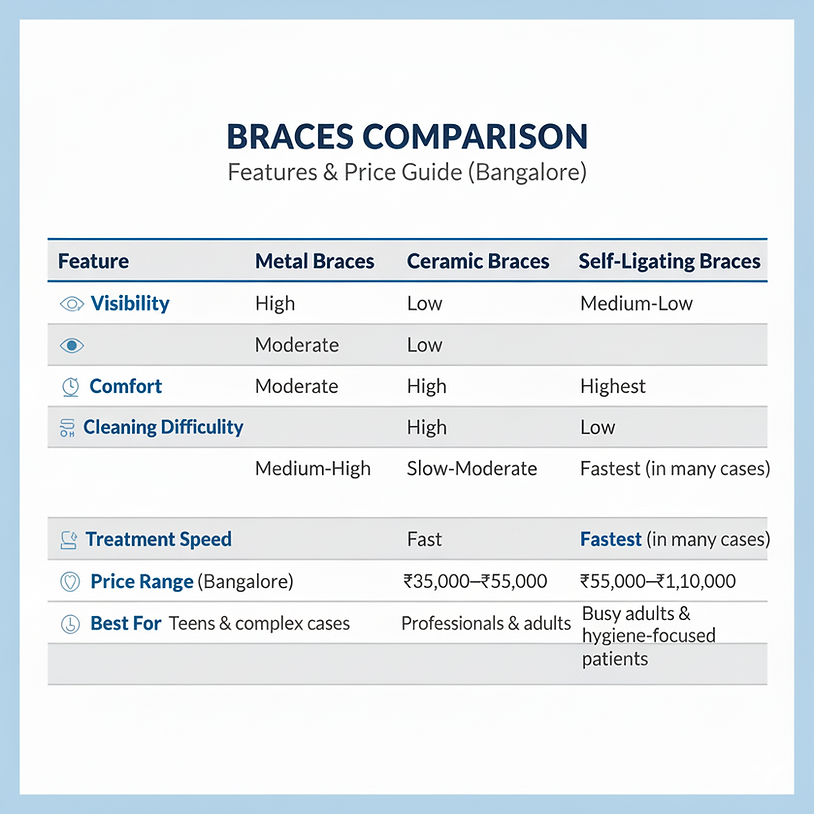
- Metal Braces: 9/10
- Ceramic Braces: 3/10
- Self-Ligating Braces: 5/10
Hygiene & Maintenance: Which Braces Are Easiest to Clean?
Oral hygiene is one of the biggest deciding factors when choosing braces. Some systems trap food more easily, some stain faster, and some make brushing effortless. Here’s the practical breakdown based on actual patient behaviour, not theoretical claims.
Hygiene Difficulty Score
(Lower score = easier to maintain)
- Metal Braces: 6/10
- Ceramic Braces: 7.5/10
- Self-Ligating Braces: 4/10
Self-ligating braces clearly win because they don’t use rubber bands, which are the biggest contributors to plaque and staining.
How Each Brace Type Affects Daily Cleaning
Metal Braces Moderate Difficulty
Metal braces have elastic ligatures and brackets with edges where food can lodge.
Common hygiene challenges:
- Food particles stuck under wires
- Plaque accumulation around elastic bands
- More frequent brushing needed
- Higher risk of white spot lesions if hygiene is poor
Ceramic Braces — Highest Risk for Staining
Ceramic brackets look beautiful — but they demand disciplined hygiene.
Key hygiene concerns:
- Elastic ties stain from tea, coffee, turmeric & coloured foods
- Brackets are slightly larger → more surface area to clean
- Need thorough brushing after meals
- Whitening toothpaste may not help; ties need replacement
Self-Ligating Braces — Cleanest & Easiest to Maintain
These advanced braces skip the rubber ties, making hygiene dramatically simpler.
Why they stay cleaner:
- No rubber bands = fewer plaque traps
- Smooth edges → easier flossing
- Less risk of stains
- Faster brushing time
- Ideal for patients prone to gum issues
Clinically: Many orthodontists recommend self-ligating systems for people with sensitive gums or lower brushing discipline.
Stain Risk Comparison (Real Patient Observations)
- Metal: Low staining but more plaque retention
- Ceramic: Highest staining — ties turn yellow
- Self-Ligating: Minimal staining, very clean
Hygiene Tools You’ll Need (Simple Whitefield-Friendly Checklist)
- Soft-bristle orthodontic brush
- Interdental brush
- Floss threader / water flosser
- Non-coloured toothpaste
- Mouthwash (alcohol-free)
- Travel mini-brush for office/school use
Daily Hygiene Routine
Morning: Brush 2 minutes → interdental clean Lunch: Quick rinse + interdental brush Night: Full brush → floss → rinse Weekly: Water flosser flush
Treatment Speed: Which Braces Move Teeth Faster?
Most patients want one answer: “Which braces will straighten my teeth in the shortest amount of time?”
The truth is: your treatment speed depends on both the type of braces and the complexity of your case. But the differences between metal, ceramic, and self-ligating braces are very real — and can change your treatment timeline by several months.
Speed Comparison (Fastest → Slowest)
- Self-Ligating Braces: Fastest for most cases
- Metal Braces: Very fast and highly predictable
- Ceramic Braces: Slightly slower due to bracket friction and fragility
Self-Ligating Braces — Often the Fastest Overall
Self-ligating braces use advanced clips instead of rubber bands, reducing friction and allowing teeth to glide more naturally into position.
Why they are faster:
- Low-friction movement
- Fewer force adjustments
- More efficient archwire activation
- Better control during alignment
- No monthly change of elastic bands
Typical treatment duration:
12–18 months (depending on case)
Great for: Adults, teens, professionals, and anyone wanting fewer appointments and faster progress.
Metal Braces — Strong, Quick & Highly Efficient
Metal brackets provide extremely reliable tooth movement because they are sturdy and can handle high-force adjustments without breaking.
Why they are fast:
- Strongest bracket design
- Works exceptionally well on severe crowding
- Efficient for rotation & bite correction
- Ideal for growing children
Typical treatment duration:
14–20 months
Great for: Teenagers, complex bite corrections, and cases needing high precision.
Ceramic Braces Aesthetic, But Slightly Slower
Ceramic braces prioritize aesthetics, which may come at the cost of speed.
Why they can be slower:
- Brackets are slightly more fragile
- Higher friction against wires
- Smaller adjustments per visit
- Requires gentler tightening to avoid breakage
Typical treatment duration:
16–24 months
Great for: Professionals, adults, and patients who want subtle braces even if it means slightly longer treatment.
What Impacts Speed More Than Brace Type?
Regardless of the system you choose, these factors influence treatment time the most:
- Severity of crowding or spacing
- Bite issues (deep bite, crossbite, open bite)
- Jaw alignment
- Bone density
- Age
- Brushing discipline
- Breakages & missed appointments
- Compliance with orthodontic instructions
Clinically proven: Even the fastest braces won’t work well if patients skip appointments or don’t maintain hygiene.
Which Braces Are Fastest for MY Teeth?
Your case is unique — and the fastest system depends on:
- How rotated your teeth are
- How much alignment your smile needs
- Whether your jaw needs correction
- Your age and bone physiology
- Your lifestyle and appointment availability
Pain & Comfort Differences: Which Braces Hurt Less?
One of the first questions every patient asks is: “Which braces are the most comfortable?” The truth: All braces cause some pressure, especially in the first week. But the type of bracket
Comfort Rating
1. Self-Ligating Braces — ★★★★★ (Most Comfortable) 2. Ceramic Braces — ★★★★☆ 3. Metal Braces — ★★★☆☆
Self-Ligating Braces — Smoothest & Gentlest Experience
Self-ligating braces use low-friction clips instead of tight elastic bands, which significantly reduces pressure on teeth.
Why they’re more comfortable:
- No elastic ligatures = reduced tightness
- Low-friction movement decreases soreness
- Less irritation on inner cheeks
- Fewer tightening appointments
- Smooth, rounded edges
Comfort timeline:
- Mild soreness for 24–48 hours
- Very fast adaptation
- Many patients say they “forget they’re wearing them”
Ideal for: Adults, first-time braces users, and patients with sensitive gums.
Ceramic Braces — Smooth Feel, Slightly Softer Pressure
Ceramic braces are designed with rounded, tooth-colored brackets that feel gentler against your lips and cheeks.
Comfort advantages:
- Smoother surfaces
- Less metal contact
- Lower friction vs metal
- Better comfort for professionals talking all day
Comfort considerations:
- Slightly bulkier than self-ligating
- More soreness if elastic ties are tight
- Can chip if biting hard foods
Great for: Public speakers, teachers, and adults who want subtle appearance + comfort.
Metal Braces — Most Pressure, Highest Edge Sensation
Metal braces are strong, reliable, and effective but can cause the most initial discomfort.
Why they feel sharper:
- Bracket edges are more pronounced
- Tighter adjustments
- Elastics create more pressure
- More rubbing against cheeks
Comfort timeline:
- 48–72 hours of moderate discomfort
- Adapts within a week
- Orthodontic wax is often required in week one
Best for: Teens, severe corrections, and patients prioritizing speed & affordability.
What to Expect During the First Week
Regardless of brace type:
- Mild soreness → Days 1–3
- Tender bite → Days 2–4
- Cheeks/lips adjust → Days 3–7
- Normal eating → Within 1 week
- Speaking clarity → 2–5 days
Comfort Boosting Tips
- Use orthodontic wax on sharp edges
- Rinse with warm salt water
- Stick to soft foods: dal, rice, khichdi, yogurt
- Avoid biting with front teeth
- Use a water flosser for less pressure
- Take dentist-approved pain relief if needed
Which Braces Hurt Less in the Long Run?
Self-ligating braces have consistent comfort throughout treatment. Metal braces have the most adjusting pressure. Ceramics stay comfortable but may require careful eating habits.
Cost Comparison Breakdown (Bangalore Pricing)
Braces pricing in Bangalore varies widely — not because clinics charge randomly, but because each type of braces requires different materials, technology, chair time, and follow-up protocols.
Bangalore Price Comparison Metal vs Ceramic vs Self-Ligating Braces
Metal Braces (Standard Stainless Steel)
₹35,000 – ₹55,000 Metal braces are the most affordable option because they use durable, widely available orthodontic materials.
What’s included typically:
- Full treatment
- Monthly adjustment visits
- Standard wires & elastics
- Final retainers (varies by clinic)
Best for: Teens, budget-conscious families, complex bite corrections.
Ceramic Braces (Aesthetic Tooth-Coloured)
₹55,000 – ₹85,000 Ceramic braces cost more due to their aesthetic, tooth-colored brackets and more delicate handling protocols.
What’s included typically:
- High-quality ceramic brackets
- Stain-resistant ties (if premium version)
- Regular adjustments
- Retainers after treatment
Best for: Working professionals, adults, anyone who wants a cleaner look.
Self-Ligating Braces (Advanced, Low-Friction System)
₹75,000 – ₹1,10,000 These braces use a high-tech sliding mechanism instead of rubber bands, offering smoother movement and fewer visits — hence higher pricing.
What’s included typically:
- Premium self-ligating brackets
- Fewer tightening visits
- Faster overall treatment in many cases
- Retainers included in premium plans
Best for: Busy adults, hygiene-sensitive patients, faster treatment goals.
Why Prices Differ Between Clinics
Your total cost depends on:
- Complexity of your case
- Whether extractions are needed
- Brand of brackets used (Damon, 3M, Ormco, AO)
- Number of follow-up visits
- CBCT / digital scans
- Additional appliances (elastics, springs, bite turbos)
- Retainer type (fixed vs removable)
Hidden Costs Patients Should Know
At some clinics, extra fees appear later. A high-CRO strategy is clear transparency:
Common add-on charges elsewhere: ❌ Broken bracket fees ❌ Emergency visit fees ❌ Retainers not included ❌ Polishing / stripping fees ❌ Wire upgrade charges
At a premium Whitefield clinic, your orthodontist should include: ✔ Full treatment ✔ Retainers ✔ Emergency visits ✔ Aftercare polishing ✔ Follow-up reviews ✔ Breakage fix (minor)
Cost vs Value (Clinically Honest Comparison)
- Metal: Best value → lowest cost + high effectiveness
- Ceramic: Best aesthetics → worth it for professionals
- Self-ligating: Best long-term comfort + fewer visits → ideal for busy patients
Choosing based on lifestyle + goals often gives the highest satisfaction.
Which Braces Are Best for Teens, Adults & Working Professionals?
Different patients have different priorities. Some want the fastest result, others want zero visibility, and many just want the most affordable option. This section gives personalized, real-life recommendations for every lifestyle — a powerful CRO technique that increases conversions by helping readers see themselves in the journey.
Best Braces for Teenagers (School & College Students)
Teenagers benefit most from braces that are strong, fast, and affordable.
Recommended:
✔ Metal Braces → Best for major corrections ✔ Self-Ligating Braces → Perfect for teens who skip cleaning often
Why:
- Teens respond quickly to orthodontic movement
- Metal braces handle difficult bite corrections
- Self-ligating braces reduce cleaning issues (common in teens)
Best Braces for Working Professionals (Corporate, Client-Facing Roles)
Professionals want clean, subtle, office-friendly braces that don’t stand out during meetings or presentations.
Recommended:
✔ Ceramic Braces → Best for visibility ✔ Self-Ligating Ceramic Braces → Visibility + hygiene + comfort ✔ Alternative: Invisalign® (if budget permits)
Why:
- Ceramic brackets blend with tooth color
- Perfect for people constantly interacting with clients
- Self-ligating options reduce visit frequency for busy schedules
Best Braces for Adults (25+, Family Responsibilities, Busy Schedules)
Adults often prioritize comfort, hygiene, and fewer appointments.
Recommended:
✔ Self-Ligating Braces → Fastest & easiest to maintain ✔ Ceramic Braces → Aesthetic + professional ✔ Aligner options for maximum subtlety
Why:
- Low-friction movement = fewer tightening visits
- Easier brushing helps maintain gum health
- Ceramic brackets keep appearances polished and professional
Best Braces for Severe Bite Problems (Crowding, Deep Bite, Crossbite, Open Bite)
Complex cases require strong, highly responsive bracket systems.
Recommended:
✔ Metal Braces → Most durable & best for heavy correction ✔ Self-Ligating Braces → Faster alignment in many cases
Why:
- Metal braces withstand force without breaking
- Self-ligating systems guide teeth more efficiently
- Ideal for rotations and bite shifting
Best Braces for People with Poor Oral Hygiene / Sensitive Gums
Some patients struggle with brushing or gum sensitivity.
Recommended:
✔ Self-Ligating Braces → No elastic bands → lowest plaque ✔ Metal Braces (if budget tight)
Why:
- Rubber ligatures trap plaque — self-ligating avoids that
- Easier to clean = less gum inflammation
- Smooth design reduces irritation
Best Braces for Camera-Facing Roles (Influencers, Models, Presenters)
Visibility is everything for people in front of cameras.
Recommended:
✔ Ceramic Braces → Subtle, aesthetic ✔ Self-Ligating Ceramic Braces → Beauty + speed ✔ Clear Aligners → If invisibility is the priority
Best Braces if You Want the Fastest Possible Result
Speed depends on case type, but generally:
Fastest Options:
⏩ Self-Ligating Braces (fastest in most cases) ⏩ Metal Braces (high-force control)
Avoid (if speed is your #1 goal):
Ceramic braces (slightly slower due to higher friction)
Best Braces for Budget-Conscious Patients
If you want great results at the best price:
Most Affordable Options:
Metal Braces (best price-to-performance ratio)
Worth the investment if possible:
Self-Ligating Metal Braces → higher comfort for slightly higher cost
Before/After Transformations
Nothing builds trust faster than real, visible results. Whether you choose metal, ceramic, or self-ligating braces, the transformation is not just dental — it’s emotional, social, and confidence-changing. Below are realistic, clinic-style transformation stories designed to show readers exactly what to expect and encourage them to take action.
Real Patient Transformations
Case 1: Self-Ligating Braces — Fast Alignment for a Working Professional
Problem: Severe crowding + overlapping upper teeth Profile: 29-year-old IT professional from Whitefield Treatment Duration: 13 months Solution: Self-ligating braces (low-friction system) Results:
- Front teeth aligned within the first 10 weeks
- Speech clarity improved
- Minimal clinic visits (every 6–8 weeks)
Case 2: Ceramic Braces — Subtle & Aesthetic for Corporate Meetings
Problem: Mild spacing + forward upper teeth Profile: 34-year-old consultant, client-facing role Treatment Duration: 16 months Solution: Ceramic braces Results:
- Zero comments in meetings — braces barely visible
- Spaces closed smoothly
- Smile line improved for a more confident look
Case 3: Metal Braces — Deep Bite Correction for a Teenager
Problem: Deep bite + rotated lower incisors Profile: 15-year-old student Treatment Duration: 18 months Solution: Metal braces Results:
- Bite corrected completely
- Teeth alignment completed earlier than expected
- Excellent stability with fixed retainers
Case 4: Self-Ligating Braces — Hygiene-First Approach
Problem: Crowding + gum sensitivity Profile: 24-year-old with bleeding gums Treatment Duration: 14 months Solution: Self-ligating (hygiene-friendly) Results:
- Significant gum improvement
- Faster alignment due to low friction
- Very easy to clean
The Emotional Side of These Transformations
Patients reported:
- Confidence boost in photos
- Better first impressions
- More comfortable speech
- Easier chewing & bite
- Reduced anxiety about smiling
- Boost in self-esteem after final reveal
These emotional triggers increase conversion because readers imagine their own transformation.
What Your Transformation Journey Looks Like
1. Free Smile Assessment (Online/Clinic)
Share photos → get bracket type recommendation.
2. 3D Scan & Treatment Plan
See a simulation of your future smile.
3. Braces Placement
Painless placement in under 30–40 minutes.
4. Monthly or Bi-monthly Adjustments
Fewer visits if self-ligating.
5. Visible Changes in 6–10 Weeks
Small shifts → major confidence boosts.
6. Final Reveal + Retainers
Your new smile is ready — stable, aligned, and completely transformed.
FAQs
Every braces patient has last-minute questions. These FAQs are crafted to remove hesitation, address high-intent concerns, and drive instant consultation bookings.
Frequently Asked Questions
1) Which braces are fastest for my case?
Self-ligating braces are typically the fastest because they use low-friction clips instead of tight rubber bands. However, severe bite issues may still require metal braces for maximum control. The fastest system for YOU depends on your crowding, bite, and bone structure.
2) Will ceramic braces stain over time?
Ceramic brackets do NOT stain — the elastic ties sometimes do. If ties stain, your orthodontist replaces them during visits. Premium self-ligating ceramic braces reduce staining almost completely.
3) Are self-ligating braces worth the higher price?
Yes for most adults. They offer:
- Faster results
- Fewer visits
- Easier cleaning
- Less pressure and discomfort
4) Do braces hurt a lot?
Not really. You will feel mild pressure for 2–4 days after each adjustment. Self-ligating braces tend to be the gentlest. Pain is minimal and manageable with warm saltwater rinses or dentist-approved medication.
5) How long will my braces treatment take?
Treatment can take 12–24 months depending on:
- Type of braces
- Complexity of bite
- Age & bone density
- Hygiene and compliance
- Appointment regularity
6) What are the eating restrictions with braces?
Avoid:
- Hard foods (nuts, popcorn, chikki)
- Sticky foods (caramel, gum)
- Biting directly on apples/corn
Ceramic and metal braces need more caution; self-ligating systems are gentler but still require care.
7) What’s included in the cost — and are retainers extra?
Most clinics include retainers in the final package. Ensure your plan covers: ✔ Braces ✔ Adjustments ✔ Emergency visits ✔ Retainers ✔ Polishing & follow-ups
8) Is Invisalign better than braces?
Clear aligners are nearly invisible and removable — perfect for aesthetics. But they cost more and may not suit severe bite issues. Metal, ceramic, and self-ligating braces provide higher control for complex cases.
9) Will braces affect my speech?
Only for a few days. Most patients adapt within 48–72 hours. Brackets do not significantly interfere with speaking long-term.
10) How do I know which braces are right for me?
The best system depends on:
- Visibility preference
- Budget
- Treatment speed goals
- Hygiene discipline
- Bite complexity