Introduction
Your tooth has been sending signals. A deep ache that nothing seems to touch. A sharp jolt when you sip hot tea, and the discomfort lingers for thirty seconds after the cup is down. A jaw soreness that wakes you at 3 AM for no apparent reason. You have been hoping it would pass. It has not.
These are not random dental nuisances. They are specific, clinically meaningful symptoms, your tooth’s way of communicating that something has gone seriously wrong inside the pulp, the soft tissue at the core of every tooth that houses nerves, blood vessels, and connective tissue. When that tissue becomes irreversibly inflamed or infected, it cannot heal on its own.
This guide explains every warning sign, with clinical accuracy to help you understand why each symptom means what it means, and the honesty to tell you what happens when those symptoms are ignored.
Key Statistics at a Glance
| Statistic | Detail |
|---|---|
| 15M+ procedures | Root canal procedures are performed annually (AAE estimate) |
| 30 seconds | Cold sensitivity lasting 30+ seconds = irreversible pulpitis = root canal needed |
| 6× more likely | Root canal patients are 6x more likely to describe the procedure as painless vs extraction |
| 0% | Chance a dental infection resolves on its own without treatment |
What Is Actually Happening Inside Your Tooth
Every tooth has three layers. The outermost layer, enamel, is the hardest substance in the human body. Beneath it sits dentine, a porous yellowish tissue containing thousands of microscopic tubules that communicate sensory information to the pulp. At the very centre of every tooth is the pulp: soft living tissue containing nerves, blood vessels, and connective tissue that extends from the crown down through the root canals to the apex of each root.
When bacteria reach the pulp, they cause inflammation, pulpitis. Initially, this inflammation may be reversible: the pulp is irritated but can recover if the source (cavity or crack) is removed. If the inflammation is allowed to progress, the pulp moves into irreversible territory, too damaged to heal. Dying pulp tissue releases bacterial toxins through the root tip into the surrounding bone, establishing a periapical infection.
Reversible vs Irreversible Pulpitis: The Critical Distinction
The distinction between reversible and irreversible pulpitis is the most clinically important line in dentistry. It determines whether your tooth needs a filling or a root canal.
Reversible Pulpitis, Often Treatable with a Filling
- Brief, sharp pain when cold or sweet food contacts the tooth
- Pain disappears within 1–5 seconds of removing the stimulus
- No spontaneous pain, only pain when provoked
- No sensitivity to heat
- No pain when biting (in most cases)
- Gum is normal, no swelling or tenderness
Irreversible Pulpitis, Root Canal Treatment Required
- Sensitivity to cold lingers 30+ seconds after removal
- Sensitivity to heat that does not resolve quickly
- Spontaneous pain occurs without any food, drink, or stimulus
- Deep, throbbing pain, often worse lying down
- Pain radiating to the jaw, ear, temple, or other teeth
- Pain when biting or pressing on the tooth
8 Signs You Need a Root Canal, Explained in Full
Sign 1: Persistent Toothache That Won’t Respond to Painkillers
Urgency: Moderate, Do not delay more than 48 hours
A deep, throbbing, or constant ache in a tooth that does not respond adequately to over-the-counter pain medication is one of the most reliable indicators that something is seriously wrong inside the pulp. A normal toothache typically responds at least partially to analgesics. Dental pulp infection creates a pressure environment inside the sealed root canal that no painkiller can meaningfully address.
Root canal-level pain is typically described as deep rather than sharp, constant or recurring rather than occasional, and often throbbing, pulsating in sync with the heartbeat. It may come and go in waves, but it does not fully resolve the way simpler dental pain does.
Sign 2: Sensitivity to Heat That Lingers After the Stimulus Is Gone
Urgency: High, Book within 24 hours
Of all the temperature sensitivity patterns, lingering sensitivity to heat is the most diagnostically specific sign of irreversible pulpitis. When a tooth with irreversibly inflamed pulp is exposed to a hot stimulus, the heat causes the inflamed pulp to swell further within the sealed root canal, dramatically increasing internal pressure.
The pain this generates can last minutes rather than seconds. In advanced cases, patients report that cold water actually relieves the heat-triggered pain temporarily, a paradoxical response that is pathognomonic (uniquely diagnostic) of irreversible pulpitis.
Sign 3: Cold Sensitivity That Does Not Resolve Quickly
Urgency: High, Evaluate within 24–48 hours
Cold sensitivity by itself does not always indicate a root canal. Brief sensitivity to cold that disappears within 5–10 seconds is often reversible pulpitis, treatable with a filling. However, when cold sensitivity lingers for 30 seconds or more after the cold stimulus is removed, the clinical picture changes completely.
This extended response indicates that the C-fibres of the pulp, the slow-responding pain fibres that signal chronic, deep tissue inflammation, have been activated. The inflammation is no longer reversible.
Sign 4: Pain When Biting or Applying Pressure to the Tooth
Urgency: Moderate-High, Evaluate within 48 hours
When biting down causes pain in a specific tooth, the infection has progressed beyond the pulp itself. This is called percussion sensitivity or apical periodontitis. It occurs when bacterial toxins from the dying pulp have leaked through the root apex into the periodontal ligament, the cushioning tissue between the root and the jawbone.
Patients often describe the tooth feeling ‘high’ or ‘raised’ even without any external stimulus. In some cases, they avoid eating on that side entirely. When biting pain is accompanied by temperature sensitivity or swelling, the case for root canal treatment is strong.
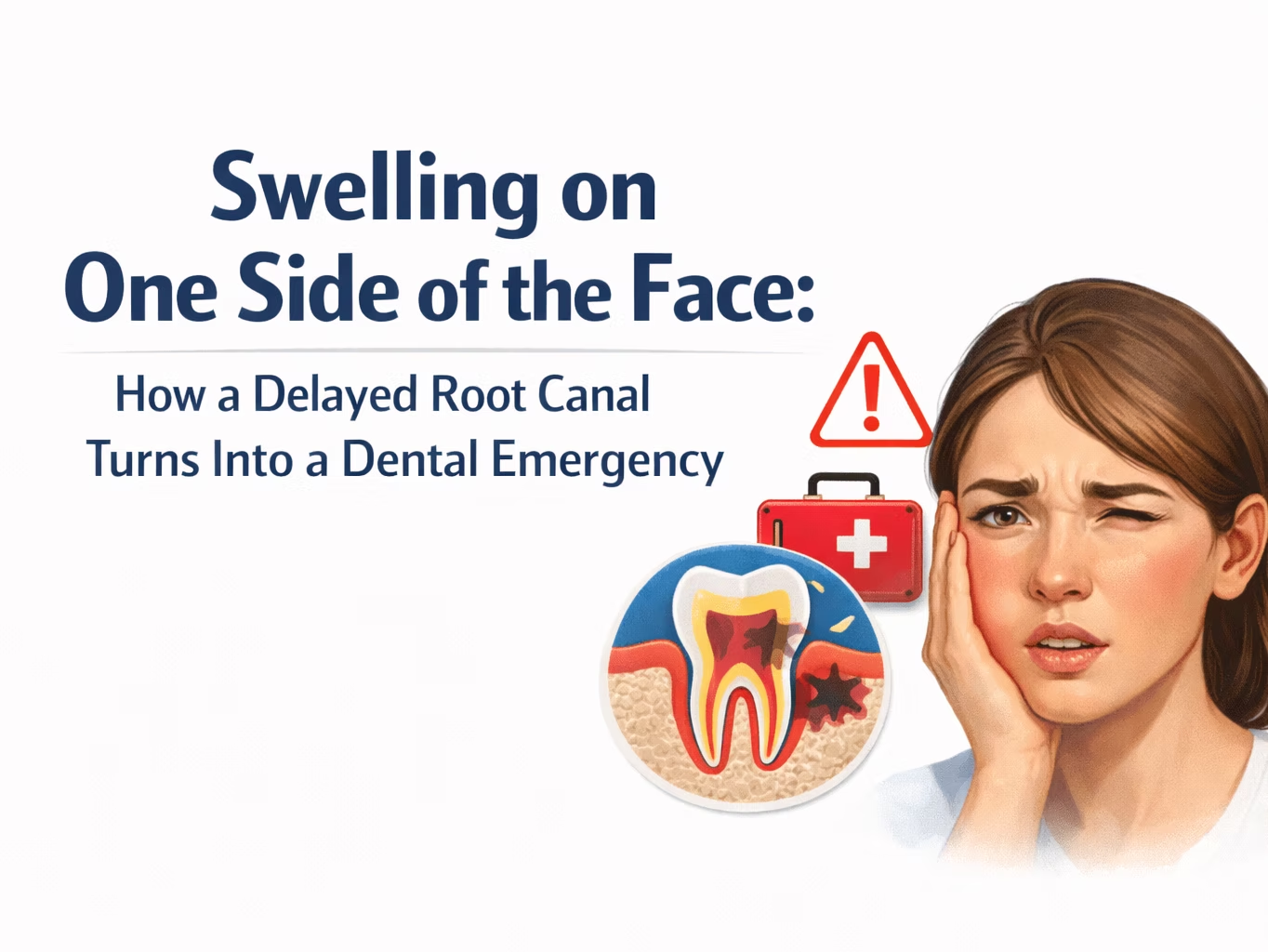
Sign 5: Swelling of the Gum, Face, or Jaw
Urgency: URGENT, Seek care the same day
Swelling adjacent to a tooth is the visible manifestation of an established dental abscess. When the infection originating in the pulp spreads through the root apex into the surrounding bone, the immune system attempts to contain it by walling it off with a collection of pus. This pushes through the bone and periosteum into the surrounding soft tissue, producing the visible swelling.
Swelling localised to the gum near a single tooth is serious but manageable with same-day dental treatment. Swelling extending to the cheek, jaw, or face indicates the infection has moved into the facial soft tissues. Swelling involving the floor of the mouth, neck, or causing difficulty swallowing or breathing is a medical emergency requiring immediate hospitalisation.
Sign 6: A Pimple or Bump on the Gum (Sinus Tract)
Urgency: Urgent, Book within 24 hours, even if painless
A small, pimple-like bump on the gum near a tooth, sometimes with a visible white or yellow centre, is called a sinus tract (historically called a ‘gum boil’ or parulis). This bump forms when a periapical abscess creates a drainage channel through surrounding bone and gum tissue to the surface.
When the abscess drains, it temporarily relieves internal pressure, which can make the pain subside or disappear. This is one of the most dangerous scenarios in dentistry: the infection is at its most destructive at precisely the moment the patient feels the least pain. The chronic active infection continues to progress, bone destruction continues to expand, and the window for successful root canal treatment is narrowing.
Sign 7: Tooth Darkening or Grey Discolouration
Urgency: Moderate, Evaluate within 1–2 weeks
A tooth that has gradually turned darker, grey, brown, or noticeably darker than adjacent teeth has almost certainly undergone internal changes indicating pulp necrosis (death of the pulp tissue). When the pulp dies, blood vessels within it break down and release iron-containing haemoglobin breakdown products. These haemoglobin metabolites penetrate the dentinal tubules and stain the tooth from the inside out.
Importantly, a tooth can be completely necrotic, with dead pulp and an active infection, and feel absolutely no pain. The nerve has died. Patients interpret this silence as improvement. It has not healed. The infection continues to spread, and the bone continues to be destroyed. Any tooth that has noticeably darkened compared to previously warrants a dental X-ray to assess periapical status.
Sign 8: Spontaneous Pain, Especially at Night
Urgency: Urgent do not attempt to wait this out
Pain that appears without any stimulus, no food, no drink, no biting, no temperature, is called spontaneous pain, and it is one of the most definitive clinical signs of irreversible pulpitis or pulp necrosis. When the inflamed pulp generates pain without external provocation, the nerve is firing autonomously, generating pain signals in the absence of any appropriate stimulus.
Spontaneous dental pain is frequently worse at night. When you lie down, increased blood pressure and venous congestion in the inflamed pulp cause pressure to build further. Gravity is no longer assisting venous drainage. Distractions from the daytime are absent. If you are waking at night with tooth pain that has no obvious trigger and does not quickly resolve when you shift position, book a dental appointment first thing in the morning.
Additional Signs That Warrant Dental Assessment
A Cracked or Chipped Tooth with Sensitivity
Cracks allow bacteria to penetrate toward the pulp. A visible crack combined with temperature sensitivity or biting pain may mean the pulp is already compromised. Cracked tooth syndrome often requires root canal treatment, and in severe cases where the crack extends below the gum line, extraction.
Recurring Bad Taste or Odour
A persistent bad taste in the area of a specific tooth, especially first thing in the morning, often indicates an active dental abscess draining into the mouth through a sinus tract. If you notice a foul taste that you cannot link to food coming from a specific area, it warrants evaluation.
Tooth Feels Loose
A tooth that has become slightly mobile, especially one that was previously solid, may have significant bone destruction from a chronic periapical infection. Bone resorption from a spreading abscess reduces the foundation supporting the tooth. This is a late-stage sign requiring immediate evaluation.
Fever or Swollen Neck Lymph Nodes
Fever accompanying tooth pain indicates the infection is no longer localised; it has entered systemic circulation. Swollen, tender lymph nodes under the jaw or in the neck are the immune system’s response to a spreading dental infection. Both are emergency symptoms requiring immediate dental or hospital care.
Pain Following Old Dental Work
A tooth with a deep filling, crown, or previous restorations is at higher risk of pulp inflammation over time, each procedure produces heat and microtrauma, and deep restorations are closer to the pulp. Pain developing months or years after dental work on a specific tooth should prompt pulp vitality evaluation.
Visible Dark Spot or Hole in the Tooth
A visible cavity, darkened area or visible hole indicates that decay has progressed significantly. If accompanied by any sensitivity or pain, the pulp is likely compromised. Even without symptoms, visible decay that has clearly penetrated deep warrants X-ray evaluation.
The Silent Tooth: When You Need a Root Canal With No Pain
One of the most important, and least understood, aspects of dental infection is that a tooth requiring root canal treatment may have absolutely no pain. This is not a reassuring finding. It is a dangerous one.
When pulp inflammation progresses to pulp necrosis, the death of the pulp tissue, the nerve fibres die along with the rest of the tissue. Dead nerves cannot transmit pain signals. The result is a tooth that has gone quiet, not because it has healed, but because its alarm system has failed. The infection continues to spread.
These painless necrotic teeth are identified by:
- Sinus tract (gum pimple), typically associated with minimal or no pain
- Progressive tooth darkening or grey discolouration
- Periapical radiolucency visible on dental X-ray, shadow at root tip indicating bone destruction
- No response to cold or heat during dental testing, the tooth shows no vitality
- Swelling that appears without preceding pain, because the infection has been progressing silently
Does This Symptom Mean a Filling or a Root Canal?
Only a clinical examination and X-ray can definitively confirm which treatment is appropriate. The following guide gives you the best pre-examination framework:
| Stage | Symptoms & Likely Treatment |
|---|---|
| Stage 1: Early Decay | Brief cold sensitivity, no spontaneous pain, no heat sensitivity. Most likely reversible pulpitis. May be treatable with a filling if caught now. |
| Stage 2: Moderate Decay | Moderate cold sensitivity, occasional biting sensitivity, no lingering pain. Could be reversible or early irreversible pulpitis. X-ray and clinical testing are required to distinguish. |
| Stage 3: Pulp Involvement | Lingering cold/heat sensitivity (30+ sec), spontaneous pain beginning, and pain on biting. Almost certainly irreversible pulpitis. Root canal treatment is indicated. |
| Stage 4: Periapical Infection | Swelling, sinus tract, severe biting pain, spontaneous pain, and possible fever. Root canal treatment is necessary and urgent. |
| Stage 5: Spreading Infection | Facial swelling, fever, difficulty swallowing, and swollen neck lymph nodes. Dental emergency. Seek same-day dental and potentially medical care immediately. |
Managing Tooth Pain While You Wait for a Dental Appointment
These measures provide temporary symptom relief only. They are not treatment. A dental infection will not resolve with painkillers. Use these to get through the hours until you can be seen, not as a reason to delay the appointment.
Ibuprofen (Adults Without Contraindications)
400–600mg every 6–8 hours with food. Reduces both pain and inflammation, a dual benefit for dental pulp-related pain. Not suitable for those with kidney disease, gastric ulcer, blood thinners, or certain cardiac conditions.
Paracetamol
500–1000mg every 4–6 hours. Safe for most patients. Can be taken together with ibuprofen for stronger combined pain relief. Maximum 4,000mg per day.
Clove Oil (Eugenol)
Dip a small cotton pellet in clove oil and apply gently to the affected tooth, not the gum. Eugenol has mild local anaesthetic and antibacterial properties. Provides short-term topical relief.
Cold or Room-Temperature Foods Only
Avoid hot foods and drinks entirely if you have heat sensitivity, as they will dramatically worsen the pain. Stick to room temperature or lukewarm foods. Avoid chewing on the affected side.
Head Elevation When Sleeping
Keeping your head elevated (extra pillow, semi-reclined) reduces venous pressure in the inflamed pulp and may slightly reduce the intensity of spontaneous night pain.
What NOT to Do
- Do not apply aspirin directly to the gum; it causes chemical burns to soft tissue.
- Do not use the tooth to chew anything on the painful side
- Do not apply heat to the face for dental pain; heat worsens dental infection
- Do not delay more than 24–48 hours for anything beyond very mild discomfort
What Happens When You See the Dentist for These Symptoms
1. Patient History
The dentist will ask about the character of the pain (sharp vs dull vs throbbing), duration (brief vs lingering), triggers (cold, heat, biting, spontaneous), and timeline. This history is the most important part of endodontic diagnosis; it is what distinguishes reversible from irreversible pulpitis before any test is performed.
2. Clinical Examination
The dentist examines the tooth visually for cracks, fractures, deep restorations, or visible decay. The gum is checked for swelling, sinus tracts, or colour changes. Adjacent teeth and gum tissue are examined for comparison.
3. Cold Testing (Pulp Vitality Test)
A cold stimulus is applied to the tooth and adjacent teeth for comparison. A normal response is brief sensitivity that disappears within 5–10 seconds. An exaggerated response lingering 30+ seconds indicates irreversible pulpitis. No response indicates likely pulp necrosis. Both extreme responses indicate root canal treatment is needed.
4. Percussion Test
The dentist taps gently on the biting surface of the tooth. Pain on percussion indicates periapical periodontitis; the infection has spread beyond the pulp to the periapical tissues. This is a positive percussion test and confirms root canal treatment is needed.
5. Palpation
The dentist presses on the gum and bone over the root apex. Tenderness on palpation indicates periapical inflammation or abscess, confirming established periapical pathology.
6. Periapical X-Ray (IOPA)
A periapical X-ray is taken of the affected tooth and surrounding bone. This shows the full length of the root(s), the bone around the root apex, any periapical radiolucency (shadow at root tip indicating bone destruction), the quality of any existing restoration, and the position of the pulp chamber.
7. Diagnosis and Treatment Plan
Based on all of the above, the dentist formulates a diagnosis. Diagnoses follow standardised terminology: reversible pulpitis, symptomatic irreversible pulpitis, pulp necrosis, symptomatic apical periodontitis, asymptomatic apical periodontitis, or acute apical abscess.
Conclusion: Your Tooth Is Telling You Something. Listen.
The symptoms described in this guide are not random dental discomforts. Each one is a clinically specific signal from a pulp that is either inflamed beyond recovery, dying, or already dead, and an infection that, without treatment, will keep spreading.
The correct response to any symptom on this list is to book a dental appointment, have the tooth examined and X-rayed, and understand what is actually happening. In most cases, the treatment, when caught at the right stage, is a single-visit root canal under local anaesthesia that resolves the pain, preserves a tooth you would otherwise lose, and prevents a spreading infection that would be dramatically harder and more expensive to manage.