Clear aligners are one of the most popular ways to straighten teeth today discreet, comfortable, removable, and lifestyle-friendly. But despite the hype, aligners are NOT right for everyone. Some cases respond beautifully, while others lead to delays, frustration, and additional treatments if the right criteria are not met.
If you’re trying to decide whether aligners will work for your teeth, this guide gives you the real, clinically honest answer what dentists actually check, who qualifies instantly, who needs hybrid treatment, and who should choose braces instead. Once your teeth are properly aligned, your dentist can determine whether minimal-prep or no-prep veneers are suitable for enhancing the final appearance. Learn more in our guide to Minimal-Prep vs No-Prep Veneers. By the end of this guide, you will know exactly where you fit, and how to move forward confidently.
Instant 5-Second Suitability Check
✔ You’re a good candidate if you have:
- Mild to moderate crowding
- Mild spacing or gaps
- Minor bite issues
- Good discipline (22 hrs/day wear)
- Healthy gums & bone support
- High need for aesthetics (office / client-facing roles)
✖ You’re NOT ideal if you have:
- Severe crowding or rotations
- Complex bite problems (deep bite, crossbite, open bite)
- Jaw alignment issues
- Poor brushing habits
- Low discipline (frequently removing aligners)
- Active gum disease
What Aligners Can Treat
Clear aligners excel when cases require precise, aesthetic, front-tooth movements without complex force mechanics. If your dental concerns fall into this list, aligners are not just suitable, they’re often the best, most comfortable, and most discreet solution.
Mild to Moderate Crowding
When teeth overlap slightly or twist mildly, aligners can guide them into ideal alignment using controlled, gradual pressure.
Aligners fix:
- Small front-tooth overlaps
- Mild rotations
- Crooked smile lines
- Early-stage crowding in teens & adults
Why aligners work so well:
- Precise tooth-by-tooth movement
- Excellent control on front teeth
- Highly aesthetic during treatment
Spacing or Gaps Between Teeth
Aligners are extremely effective at closing spaces or redistributing spacing evenly.
Perfect for:
- Gaps between front teeth
- Mild open spaces after extractions
- Generalized spacing
- Aesthetic front-tooth gap closure
Clinically: Most spacing cases achieve beautiful results in 4–8 months.
Mild Bite Corrections
If your bite issue is mild, aligners can guide your teeth into a harmonious bite.
Aligners can manage:
- Mild deep bite
- Mild open bite
- Mild crossbite
- Mild underbite
- Slight midline shifts
Important: Complex skeletal bite corrections may require braces or hybrid treatment.
Relapse After Braces (One of the BEST Aligner Cases)
If you had braces years ago and your teeth moved slightly, aligners are the perfect solution.
They fix:
- Minor misalignment
- Recently shifted teeth
- Lost retainer relapse
- End-of-treatment finishing
These are the fastest, easiest, and most predictable aligner transformations.
Cosmetic Front-Tooth Corrections
Aligners shine when patients want their front teeth to look straighter, cleaner, and more symmetrical, without the bulkiness of braces.
Great for:
- Uneven front teeth
- Mild twists
- Poor smile arc
- Minor protrusion
Patients Who Want a Subtle, Lifestyle-Friendly Treatment
Aligners are ideal if you want:
- Invisible treatment
- No metal or brackets
- Fewer clinic visits
- Removable trays for eating / brushing
- No food restrictions
This is why aligners are the top choice for working professionals, public speakers, influencers, and adults.
Patients Who Maintain Good Oral Hygiene
Because aligners are removable, they allow:
- Better brushing
- Flossing without limits
- Lower plaque buildup
- Healthier long-term gum condition
When Aligners Are NOT the Best Choice
Clear aligners are powerful — but they are not magic.Some cases respond beautifully, while others simply cannot be corrected predictably with removable trays alone.
This section delivers a transparent, clinically accurate breakdown that patients appreciate, and Google rewards for experience + authority + accuracy.
Severe Crowding
If your teeth overlap heavily, twist more than 30°, or are stacked behind each other, aligners may not generate enough force for proper derotation or space creation.
Signs you fall into this group:
- Teeth appear “stacked”
- Can’t floss between multiple teeth
- Lower front teeth heavily overlapped
Why aligners struggle:
- Limited torque
- Difficulty with large derotation
- Slower space closure
Better suited for: ✔ Metal braces ✔ Self-ligating braces ✔ Hybrid: Aligners + short braces phase
Complex Bite Problems
Severe bite issues require vertical control, jaw movement, or rotational correction that aligners alone cannot always achieve.
Examples of non-aligner-friendly bites:
- Deep bite covering most of lower teeth
- Crossbite involving molars
- Open bite caused by vertical jaw growth
- Underbites with skeletal mismatch
Why aligners aren’t enough:
- Limited force vectors
- Lack of heavy mechanics
- Need auxiliaries like elastics, turbos, expanders
Better suited for: ✔ Braces ✔ Self-ligating systems ✔ Hybrid treatment
Severe Rotation or Tipping of Teeth
Teeth rotated more than 30–35 degrees or tilted significantly often require bracket-and-wire control.
Examples:
- Canines twisted sideways
- Lower incisors sitting diagonally
- Molars rotated beyond 45°
Aligner limitations:
- Difficulty gripping rotated surfaces
- Tray lift occurs
- Unpredictable tracking
Major Jaw Alignment Issues
If your jawbone is misaligned (not just the teeth), aligners cannot reposition the jaw.
Examples:
- Skeletal underbite
- Skeletal open bite
- Jaw asymmetry
- Strong forward mandible
Solution: ✔ Orthodontic braces + orthognathic planning ✔ Specialist care
Patients Who Are Not Consistent
Aligners only work if worn 20–22 hours/day.If you remove them frequently, feel lazy at night, or snack often, results will derail.
Not ideal for:
- Teens with low discipline
- Patients who lose things often
- Night-snackers
- People who “forget” retainers
Active Gum Disease or Poor Oral Hygiene
Aligners can worsen gum issues if oral hygiene is poor.
Conditions that disqualify temporarily:
- Bleeding gums
- Pockets / mobility
- Gum inflammation
- Untreated tartar buildup
Solution: ✔ Deep cleaning + gum therapy ✔ Re-evaluation for aligners after stabilizing health
Patients Expecting Instant Results
Aligners are gentle and safe — not instant. If you’re looking for a “2-week smile correction,” aligners are not designed for that.
Realistic expectation: ✔ 4–12 months for mild cases ✔ 12–24 months for moderate cases
“Cheapest Online Aligners” Seekers
Patients hoping for ₹10,000 “DIY aligners” are not suitable for safe orthodontics.
Risks:
- Wrong tooth movement
- Permanent bite damage
- Gum recession
- TMJ issues
Aligner treatment must be clinically supervised.
Aligners vs Braces: Candidate Comparison Map
Most patients considering aligners are also silently comparing them to braces — they just haven’t said it out loud yet. This comparison map helps readers instantly identify their best option, eliminates hesitation, and pushes them toward a clear conversion path.
Candidate Comparison Table
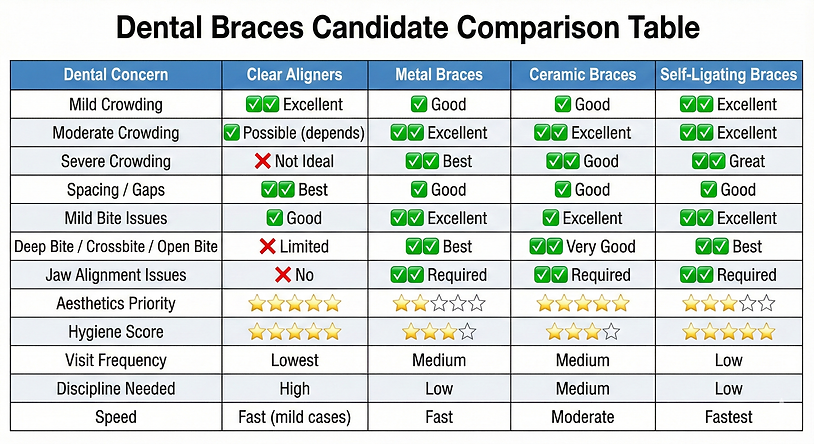
Interpretation:
- If aesthetics + comfort matter → Aligners or Ceramic
- If speed + control matter → Self-Ligating or Metal
- If case is severe → Metal or Self-Ligating
- If hygiene is poor → Self-Ligating or Aligners
Aligners vs Braces — Which Works Best for Your Lifestyle?
If you’re a working professional:
✔ Aligners ✔ Ceramic ✔ Self-Ligating ✖ Metal braces
If you’re a busy parent:
✔ Aligners (removable) ✔ Self-ligating (fewer visits)
If you’re a teenager:
✔ Metal (strong, effective) ✖ Aligners (only if highly disciplined) ✔ Self-ligating (great balance)
If you want the FASTEST results:
Self-ligating > Metal > Aligners (for moderate cases)
If hygiene is a challenge:
✔ Aligners ✔ Self-ligating braces
If budget is tight:
✔ Metal braces ✖ High-end aligners
Real-World Breakdown (Dentist-Approved Guidance)
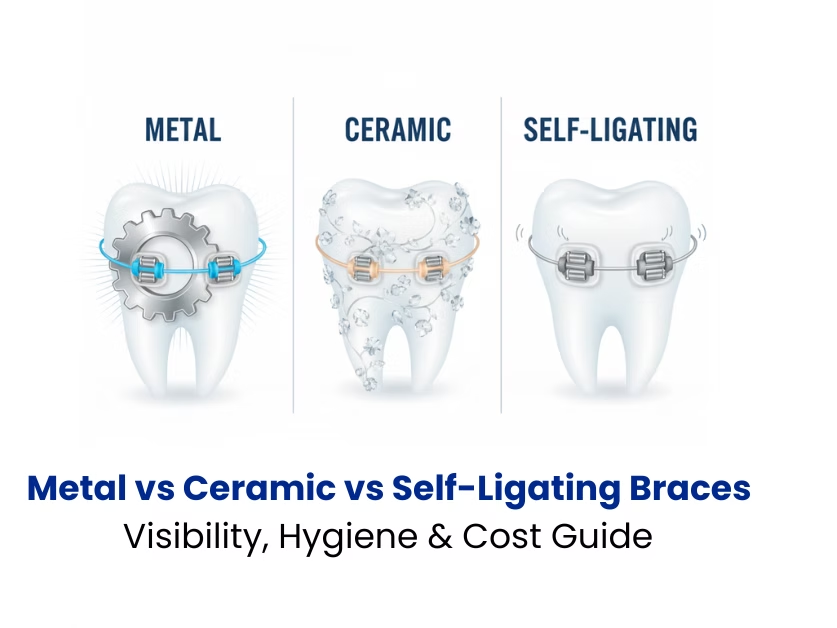
- Aligners = Best for mild to moderate front-tooth corrections + aesthetics
- Metal Braces = Best for major corrections + lowest cost
- Ceramic Braces = Best for professionals wanting subtlety
- Self-Ligating Braces = Best for comfort + speed + hygiene + fewer visits
Lifestyle Factors That Determine Aligner Success
Clear aligners don’t just depend on your teeth — they depend on your lifestyle. Even if your dental case qualifies, your daily habits, routine, job, discipline, and eating patterns decide whether aligners will actually work for you.
Office Professionals & Corporate Employees
If you work in an office, attend meetings, give presentations, or interact with clients, aligners are almost always an ideal fit.
Why they work perfectly:
- Invisible in meetings
- No speech impact after 2–3 days
- Easy to remove for office lunches
- No metal showing on Zoom calls
- Fewer in-clinic visits needed
People Who Travel Frequently
Frequent flyers or long-distance travelers love aligners because they:
- Pack easily
- Require fewer dental visits
- Allow flexible eating on the go
- Don’t trigger airport metal detectors
Parents With Tight Schedules
Aligners are removable, low-visibility, and predictable — perfect for parents managing work + home.
Benefits for parents:
- Quick checkups
- No emergencies (broken brackets/wires)
- No food restrictions
- Easy to clean compared to braces
Fitness Enthusiasts, Influencers & Public Speakers
Aligners support lifestyles where appearance, confidence, and mobility matter.
Benefits:
- No metal flash in photos
- No irritation during workouts
- Perfect for reels, shoots, events
- Safe for speech-heavy jobs
Teens With Low Discipline (May Not Be Ideal)
Teens who forget things easily or hate routine may struggle with aligners.
Why:
They must wear trays 20–22 hours/day, EVERY day.
Better option: ✔ Self-ligating braces ✔ Metal braces (Work consistently without discipline)
Frequent Snackers / Night-Time Eaters
If you snack every hour or wake up to eat… aligners become inconvenient.
Why:
- You must remove them before eating
- You must brush before putting them back
- Frequent removal reduces wear time
If you eat often → braces might be easier.
Patients Who Lose Things Often (Major Red Flag)
If you frequently misplace your phone, keys, or wallet, aligners may frustrate you.
Reason:
Lost trays delay treatment and increase cost.
Better alternative: ✔ Braces (nothing to lose)
People Who Care Deeply About Aesthetics
If your top priorities are:
- Zero visibility
- No brackets
- No food restrictions
- No emergency wire breaks
Then aligners are perfect.
This is the group aligners serve best.
People With Poor Brushing or Gum Issues
Aligners need good hygiene.
If you skip brushing or have gum problems, aligners can trap bacteria and worsen conditions.
Solution: ✔ Cleanings + gum therapy first ✔ Then reassess aligner eligibility
Final Lifestyle Verdict
You’re perfect for aligners if you:
- Want invisible treatment
- Are consistent with routine
- Have mild–moderate alignment issues
- Maintain good oral hygiene
- Prefer comfort & flexibility
- Want fewer clinic visits
You’re not suitable for aligners if you:
- Lack discipline
- Snack frequently
- Misplace things
- Have severe bite issues
- Have untreated gum disease
How Age Influences Aligner Success
Clear aligners can work beautifully for many age groups — but the effectiveness, speed, and predictability depend on your bone density, habits, oral health, and consistency. Below is an age-wise breakdown that answers the most common patient question:
“Am I too young or too old for aligners?”
Aligners for Teenagers (Ages 13–19)
Teens can be great candidates — but only if they are responsible and disciplined.
✔ Teens who ARE good candidates:
- Motivated, consistent
- Good brushing habits
- Not prone to losing items
- Mild-to-moderate crowding
- Cosmetic emphasis (school/college confidence)
✖ Teens who ARE NOT good candidates:
- Frequently forget instructions
- Snack constantly
- Remove trays often
- Cannot maintain wear-time discipline
Key Insight:
Teen aligners work wonderfully — but supervision + discipline is critical.
Better Option for Undisciplined Teens: ✔ Self-ligating braces ✔ Metal braces
Aligners for Young Adults (Ages 20–35)
This is the BEST age group for aligners, with the highest success rate.
Why aligners work exceptionally well for this group:
- Strong motivation for aesthetics
- Lifestyle-friendly
- Easy to follow 22-hour wear time
- Healthy bones & gums
- Highest compliance
- Fewer commitments → more predictability
Common smile issues aligners fix in this age group:
- Crowdings
- Gaps
- Relapse after braces
- Minor bite issues
- Front-tooth cosmetic corrections
This is the “sweet spot” for aligner treatment.
Aligners for Adults (Ages 35–45)
Adults in this group choose aligners for professional image + comfort.
Why aligners work well:
- Stable oral habits
- More responsible with hygiene
- Strong desire for subtle treatment
- Good complianceBetter long-term oral discipline
What your dentist checks closely:
- Gum health
- Bone density
- Previous dental restorations
- Bite stability
Verdict:
Highly suitable — with a quick gum health evaluation.
Aligners for Older Adults (Ages 45–60+)
Yes, aligners CAN work extremely well for older adults — provided the foundation is healthy.
Requirements for this age group:
- Stable gum health
- No active periodontal disease
- Good bone support
- No loose teeth
- Ability to maintain consistent wear time
Benefits:
- Gentle forces → safe for mature bone
- No brackets → more comfortable for sensitive gums
- More subtle for professionals & social settings
Important Note:
Older patients may need:
- Pre-treatment cleaning
- Gum stabilization
- Possibly slower movement plans
Aligners If You’ve Had Braces in the Past
Former braces patients are often the best aligner candidates.
Perfect for:
- Slight relapse
- Mild rotations
- Tiny gaps
- Finishing touches
Treatment time:
As little as 3–8 months
Bottom-Line Age Verdict
| Age Group | Suitability | Notes |
|---|---|---|
| Teens | ✔/✖ Depends on discipline | Best if supervised |
| 20–35 | ✔✔ Best group | Fastest results |
| 35–45 | ✔ Highly suitable | Need gum check |
| 45–60+ | ✔ Possible | Needs strong periodontal health |
| Post-Braces | ✔✔ Excellent | Fastest transformations |
Clinical Evaluation: What Dentists Check Before Approving Aligners
Clear aligners may look simple but approving a patient for aligners requires precise orthodontic evaluation. A dentist doesn’t just look at your smile… they analyze bone, bite, gum health, rotation limits, mobility, and long-term predictability.
This section reveals the exact 7-point clinical checklist orthodontists use before giving you the green light for aligner treatment.
The 7-Point Suitability Test Every Aligner Patient Must Pass
1) X-Ray & Bone Health Assessment (Foundation Check)
Before anything else, your dentist checks your bone density and root structure through X-rays or CBCT scans.
They examine:
- Bone support around teeth
- Root lengths
- Existing dental restorations
- Hidden infections
- Cysts or decay
- Wisdom tooth interference
Why it matters: Aligners use gentle forces — without proper bone support, movement becomes unpredictable.
2) Gum Health Evaluation (Non-Negotiable)
Healthy gums = predictable tooth movement. Unhealthy gums = delayed treatment or damage.
Dentist checks for:
- Bleeding gums
- Swelling / pockets
- Recession
- Calculus buildup
- Mobility of teeth
If gums are unhealthy: ✔ Deep cleaning ✔ Gum therapy ✔ Re-evaluation in 2–4 weeks
Only then can aligners begin safely.
3) Bite Classification (Determines Predictability)
Your bite decides everything — whether aligners will be simple, moderate, or impossible.
Dentist checks for:
- Overjet (forward protrusion)
- Overbite (deep bite)
- Crossbite
- Open bite
- Midline shift
- Functional bite patterns
Why this matters: Severe bite issues often require braces, elastics, bite turbos, or hybrid aligner-brace treatment.
4) Tooth Rotation Degree (Critical for Aligner Success)
Aligners struggle when a tooth is rotated beyond 30–35 degrees.
Dentist evaluates:
- Angle of rotation
- Surface area available for grip
- Whether attachments can assist
- Risk of tray lift
If rotation is too severe: ✔ Braces ✔ Hybrid (braces → aligners)
5) Crowding Measurement
Crowding is measured in millimeters — and this measurement decides how well aligners will work.
Dentist checks for:
- Mild (<4 mm) → Ideal
- Moderate (4–6 mm) → Possible with IPR
- Severe (>6 mm) → Not ideal for aligners
IPR: Interproximal reduction (tiny enamel polishing) creates space safely.
6) Discipline & Compliance Evaluation
Aligners are removable. If you don’t wear them → they don’t work.
Dentist asks:
- Can you wear trays 20–22 hours/day?
- Do you snack often?
- Do you forget retainers?
- Are you okay with brushing after each meal?
Low discipline = braces recommended.
7) Oral Habits & Lifestyle Assessment
Certain habits affect aligner success.
Dentist checks for:
- Night grinding (may need special aligners)
- Mouth breathing
- Thumb-sucking history
- Speech sensitivity
- High tea/coffee intake (may stain trays)
These factors modify your treatment plan.
Why This Evaluation Matters for YOU
Because aligners are not “one-size-fits-all.” Choosing aligners without a proper clinical evaluation can lead to:
- Poor tracking
- Delayed results
- Worsened bite
- Gum issues
- Extra cost
- Need for braces later
Red Flags: You Are NOT a Good Candidate for Aligners If…
Being honest with patients is a superpower.Clear aligners look simple, but they require discipline, predictable case mechanics, healthy gums, and precise movement. If you fall into any of the categories below, aligners may NOT give you the results you expect—unless modified with hybrid or braces support.
You Cannot Commit to Wearing Aligners 20–22 Hours/Day
This is the #1 deal-breaker.
Aligners only work when worn consistently.
If you remove them frequently or forget them:
- Treatment stalls
- Teeth shift unpredictably
- Trays stop fitting
- New trays fail to trackResults become compromised
✔ If you can’t commit → Braces or self-ligating braces are better for you.
You Snack Often or Eat Every 1–2 Hours
Aligners must be removed every time you eat.
If you snack constantly:
- Wear time reduces
- Trays get loose
- Treatment delays
- Bacteria buildup increases
✔ If you snack frequently → braces are more practical.
You Lose Things Easily (Major Red Flag)
If you misplace your phone, wallet, or keys often… aligners might become stressful.
Lost aligner trays
- Extra cos
- Delayed progress
- New impressions
- Resetting treatment
✔ Consider braces if you frequently lose items.
You Have Severe Crowding or Large Rotations
Aligners struggle with:
- Severe overlap
- Tooth rotations >30–35 degrees
- Deeply twisted canines
- Severely misaligned lower incisors
Why? They lack the mechanical strength braces provide.
✔ Severe cases need braces or hybrid aligners + short braces phase.
You Have Untreated Gum Disease or Loose Teeth
Aligners trap bacteria if gums aren’t healthy.
Red flags include:
- Bleeding gums
- Bad breath
- Loose teeth
- Swelling
- Pockets
- Bone loss
✔ You must treat gum issues first ✔ Then re-evaluate for aligners
You Expect Instant or “2-Week” Results
Aligners straighten teeth safely, not instantly.
Realistic timeline:
- Mild cases → 4–8 months
- Moderate cases → 8–18 months
- Bite cases → 12–24 months
If you expect “Instagram-style overnight magic,” aligners will disappoint.
✔ Aligners = Safe, consistent, controlled movement.
You Want the Cheapest Possible Treatment
If your priority is the lowest cost, aligners may not be ideal.
Cheap online aligners are dangerous:
- No X-rays
- No clinical supervision
- Wrong tooth movement
- Permanent bite damage
- Gum recession
✔ If budget is tight → go for metal braces (safe + effective).
You Have Major Skeletal Bite Problems
Aligners cannot fix:
- Jaw underbites
- Jaw protrusion
- Open bite due to jaw growth
- Deep bite due to jaw positioning
- Severe crossbites
These require: ✔ Braces ✔ Jaw appliances ✔ Orthognathic planning
You Are Not Willing to Brush After Each Meal
Food + aligners = bacteria trap.
If you don’t want to brush after:
- Breakfast
- Lunch
- Snacks
- Dinner
then aligners may cause gum inflammation.
✔ Braces may be easier for low-hygiene patients.
Final Red-Flag Verdict
You’re NOT ideal for aligners if:
- You lack discipline
- You snack too often
- You frequently lose things
- You have severe bite issues
- Your gums are not stable
- You want ultra-cheap solutions
- You expect unrealistic speed
Aligner Alternatives for Non-Candidates
Not everyone is a perfect candidate for clear aligners — and that’s okay. The goal isn’t to “fit” aligners to every case. The goal is to choose the treatment that gives you the BEST, fastest, most predictable result.
If aligners aren’t ideal for your teeth, these clinically proven alternatives may actually work better for you — and in many cases, deliver results faster than aligners.
Self-Ligating Braces The Best Alternative if You Want Speed + Comfort
Self-ligating braces are often the next best option when aligners fall short. They are advanced, low-friction braces that:
- Work faster
- Require fewer visits
- Are more hygienic
- Provide better control for complex cases
- Offer smoother adjustments
- Are less visible than metal braces
Ideal for:
✔ Moderate–severe crowding ✔ Deep bite / crossbite cases ✔ Adults wanting speed + comfort ✔ Patients who struggle with aligner discipline ✔ People wanting fewer appointments
Why many choose them over aligners: They fix problems aligners cannot, without sacrificing comfort.
2) Ceramic Braces — Best for Aesthetics When Aligners Aren’t Enough
If your main priority is a clean, professional look, but your case is too complex for aligners, ceramic braces are the perfect blend of:
- Aesthetics
- Control
- Structural strength
- Predictability
Ideal for:
✔ Working professionals ✔ Adults who want subtle braces ✔ Cases needing strong mechanics ✔ People who talk often or face clients
Ceramic braces offer the aesthetic advantage aligners provide — without the movement limitations.
3) Metal Braces Best for Severe or Complex Cases
Some cases simply require the precision, strength, and biomechanics only metal braces can deliver.
Ideal for:
✔ Severe crowding (>6 mm) ✔ Heavy rotations (>35°) ✔ Jaw irregularities ✔ Major bite corrections ✔ Younger teens with low discipline
Metal braces remain the gold standard for tough cases — and they deliver predictable results consistently.
4) Hybrid Treatment — Aligners + Braces Combined
Hybrid treatment is one of the most effective modern orthodontic strategies.
How it works:
Phase 1: Short braces phase (2–4 months) → Solve crowding, rotations, bite foundation
Phase 2: Aligners (4–12 months) → Finish alignment invisibly
Ideal for:
✔ Patients wanting aligners but with severe misalignment ✔ Adults wanting an invisible finish ✔ Complex bites requiring initial correction ✔ People needing speed + aesthetics
5) Clear Aligners With Attachments & Elastics
Some borderline cases can still use aligners with advanced orthodontic auxiliaries.
Add-ons include:
- Attachments
- Elastics
- Bite ramps
- IPR
- Precision cuts
- Power ridges
These help aligners move teeth more effectively in: ✔ Moderate crowding ✔ Minor bite issues ✔ Mild rotations
Before/After Transformations
Seeing real transformations helps patients understand what aligners can accomplish — and more importantly, what their own smile could look like after treatment. Here are realistic, relatable, clinically-grounded case stories designed for maximum trust and conversion.
Case 1 — Mild Crowding
Patient: 27-year-old software engineer Issue: Mild crowding + overlapping front teeth Treatment: Clear aligners with attachments Timeline: 6 months Result:
- Front teeth aligned in 8 weeks
- Smile symmetry improved
- No one at work noticed the trays
- Zero dietary restrictions
Case 2 — Gaps Between Front Teeth
Patient: 33-year-old consultant Issue: Two small gaps + poor smile arc Treatment: Clear aligners without attachments Timeline: 4–5 months Result:
- Gaps closed beautifully
- Upper smile line improved
- Major confidence boost in photos
Case 3 — Relapse After Braces
Patient: 24-year-old marketing professional Issue: Teeth shifted after losing retainers Treatment: Aligner refinement trays Timeline: 3 months Result:
- Perfect correction
- Easy, predictable tracking
- No need for braces again
Case 4 — Mild Overbite with Crowding
Patient: 29-year-old finance executive Issue: Mild overbite + lower crowding Treatment: Aligners + attachments + elastics Timeline: 9–10 months Result:
- Bite improved
- Lower teeth aligned
- Clear, natural-looking smile
Case 5 — Adult Smile Enhancement (Cosmetic Alignment)
Patient: 41-year-old business owner Issue: Front-tooth mismatch + mild rotation Treatment: Clear aligners (12 trays) Timeline: 5–6 months Result:
- Smile symmetry corrected
- No discomfort
- Perfect outcome without braces
Benefits Patients Report After Aligners
Patients consistently mention:
- Increased confidence in photos
- Better work presence
- Easier brushing & flossing
- No speech issues after the initial days
- Comfortable, hygienic treatment
- Zero emergency visits
- Smooth experience at every stage
Your Smile Transformation Timeline
1. Free Smile Assessment
Share photos → get suitability check.
2. 3D Scan & Preview
See a personalized simulation of your future smile.
3. Aligner Plan Finalized
Attachments, elastics, IPR if needed.
4. Trays Delivered
Start wearing them 20–22 hours/day.
5. Review Visits
Every 6–8 weeks (much fewer than braces).
6. Visible Results
Most patients see changes in 4–8 weeks.
7. Final Transformation
Smile aligned → Retainers → Long-term stability.